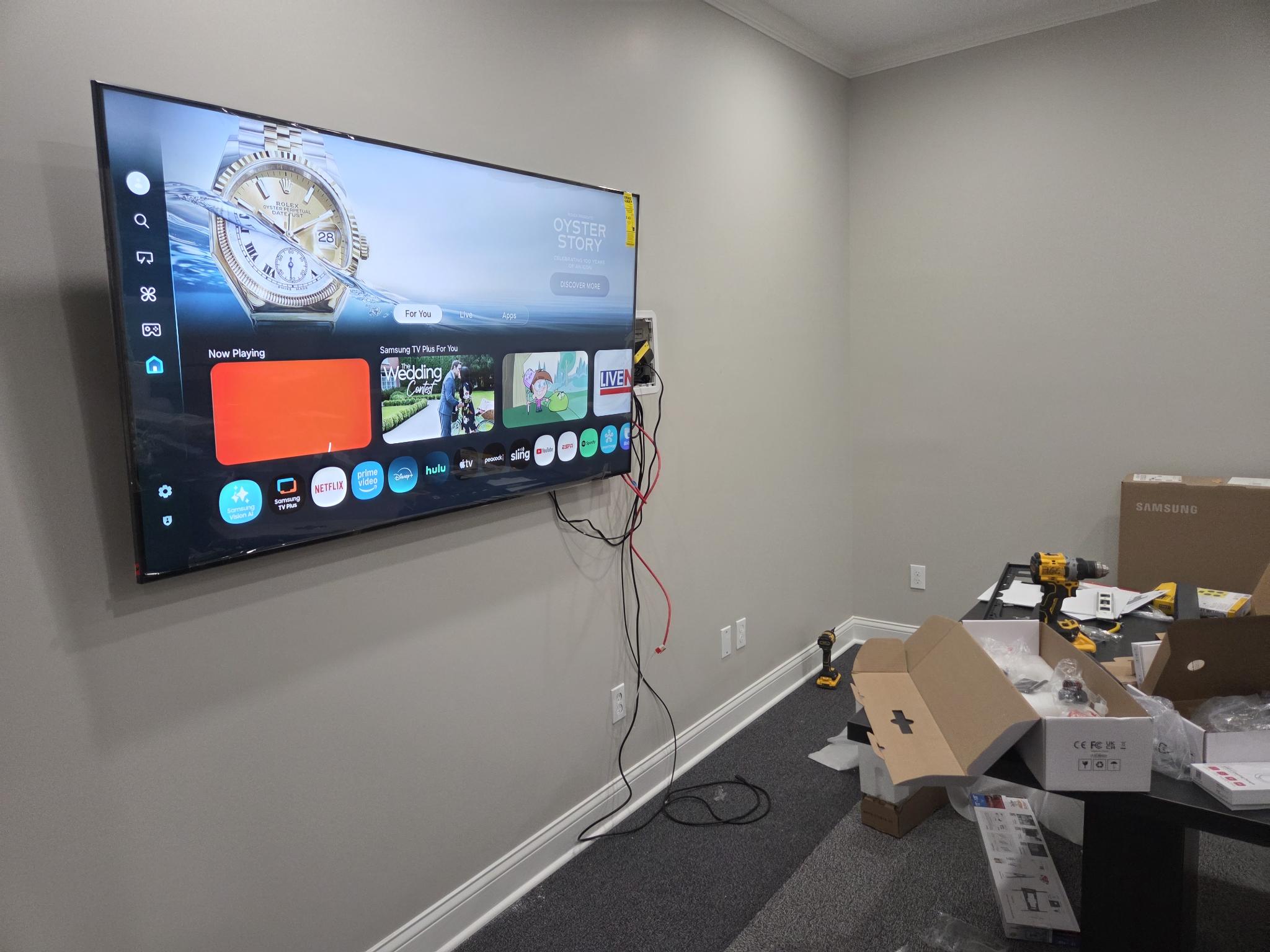
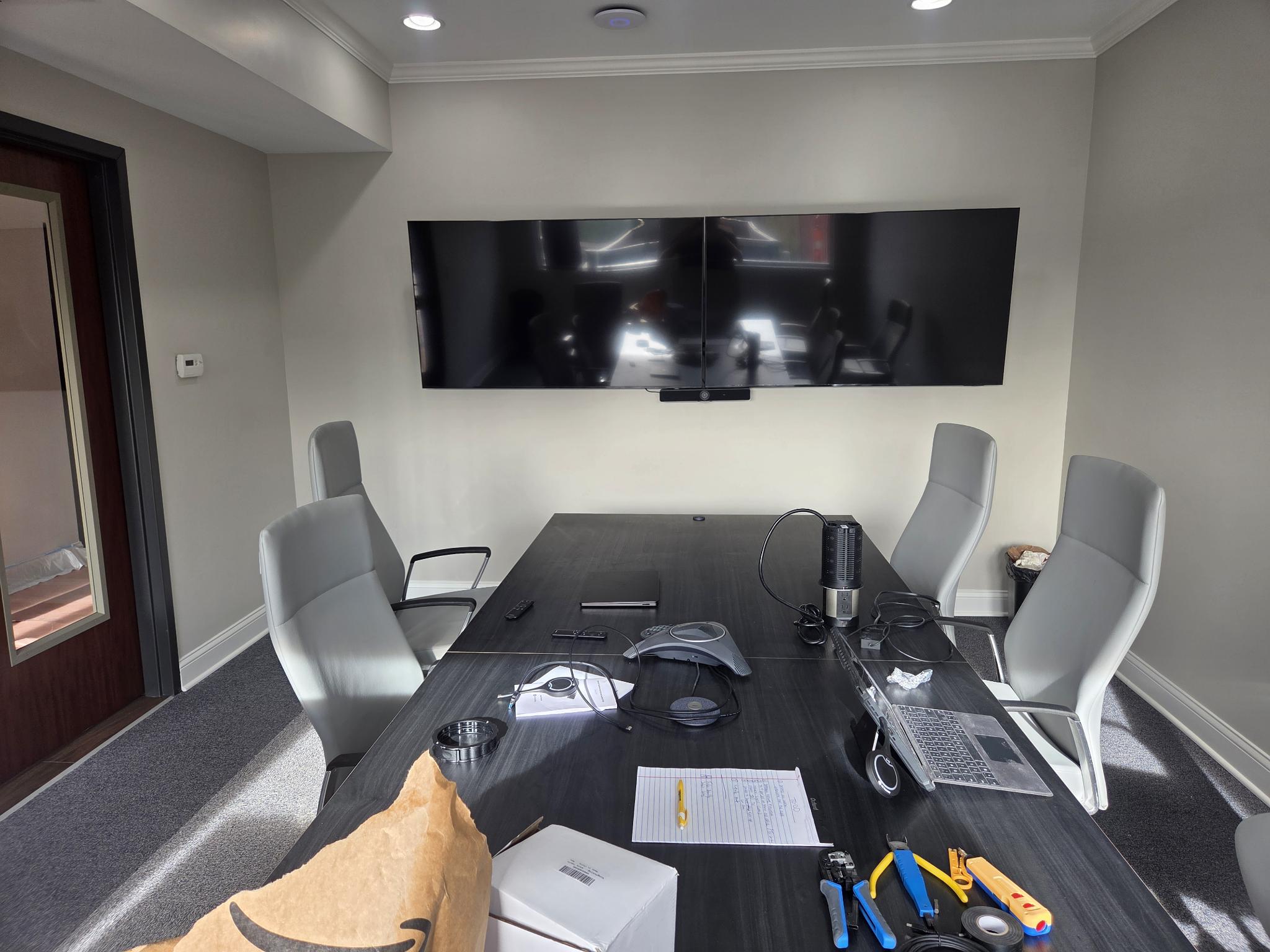
Cameras and door access for NJT Law Firm in Fenton, Missouri

At NJT Law Firm in Fenton, Missouri, 1GC installed a camera system and a controlled entry for the firm’s St. Louis metro office. The project brought together three parts of the building: the door hardware people use to enter, the cameras that record activity, and the copper cabling that carries camera traffic back to the system.

From the cable run to the door

Our crew installed pure copper Cat 6A cabling and multiple security cameras. At the entry, we installed a facial-recognition access system and a magnetic lock. The reader handles the access decision and the lock physically secures the door. Planning both together matters when a building owner wants to change how people enter an existing office.

Finding an event in recorded video

The installation included a controller and an AI Key for video analytics. That gives the firm a way to narrow a footage review to people, vehicles, or other objects of interest. For someone reviewing an event, the practical question is often where to start looking across several cameras.

Planning an office security upgrade? Our security cameras and access control services cover both sides of the entry. Request a site survey so we can walk the doors and cable routes with you, or explore our other St. Louis metro work.

Rebuilding Wi-Fi and the Fiber Backbone at Davis Conference Center

At Davis Conference Center in Layton, Utah, replacing the aging Ruckus Wi-Fi system meant following each connection back from the conference floor. A new access point needed a cable to a network closet. Each closet needed a fast path back to the core. 1GC handled that entire path, from pulling fiber and copper cable to configuring the switches, routers, and wireless network.

Connecting the network closets

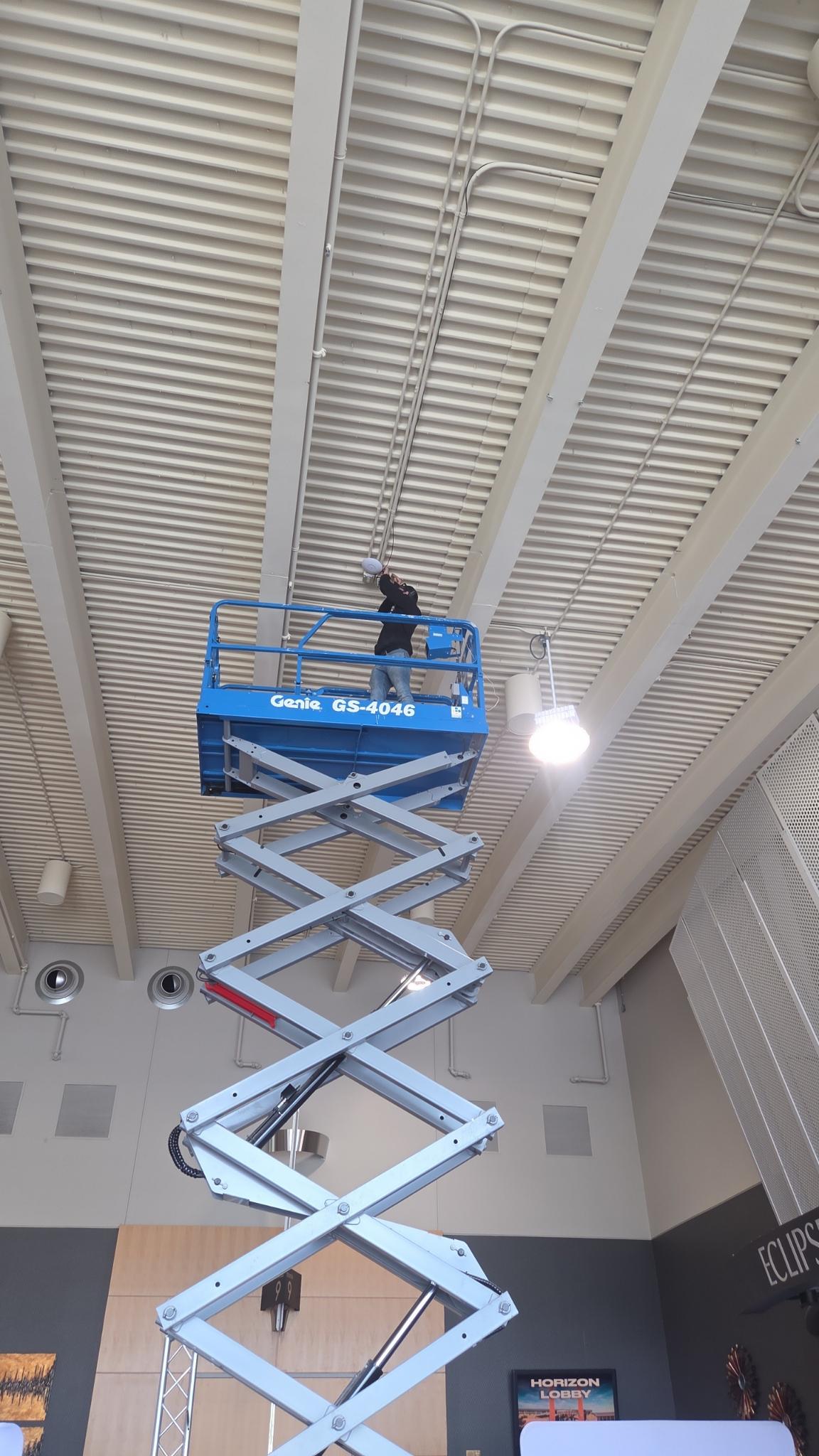
We ran OS2 single-mode fiber between the network closets and the core, giving the venue a backbone with 25-gigabit uplinks. The fiber also gives Davis room to increase capacity in the future as equipment and traffic needs change. From the closets, our crew pulled new Cat 6A runs to serve the wireless installation.

1GC technician working on overhead cabling from a scissor lift
Running overhead cabling at Davis Conference Center in Layton.

Putting 45 access points into service

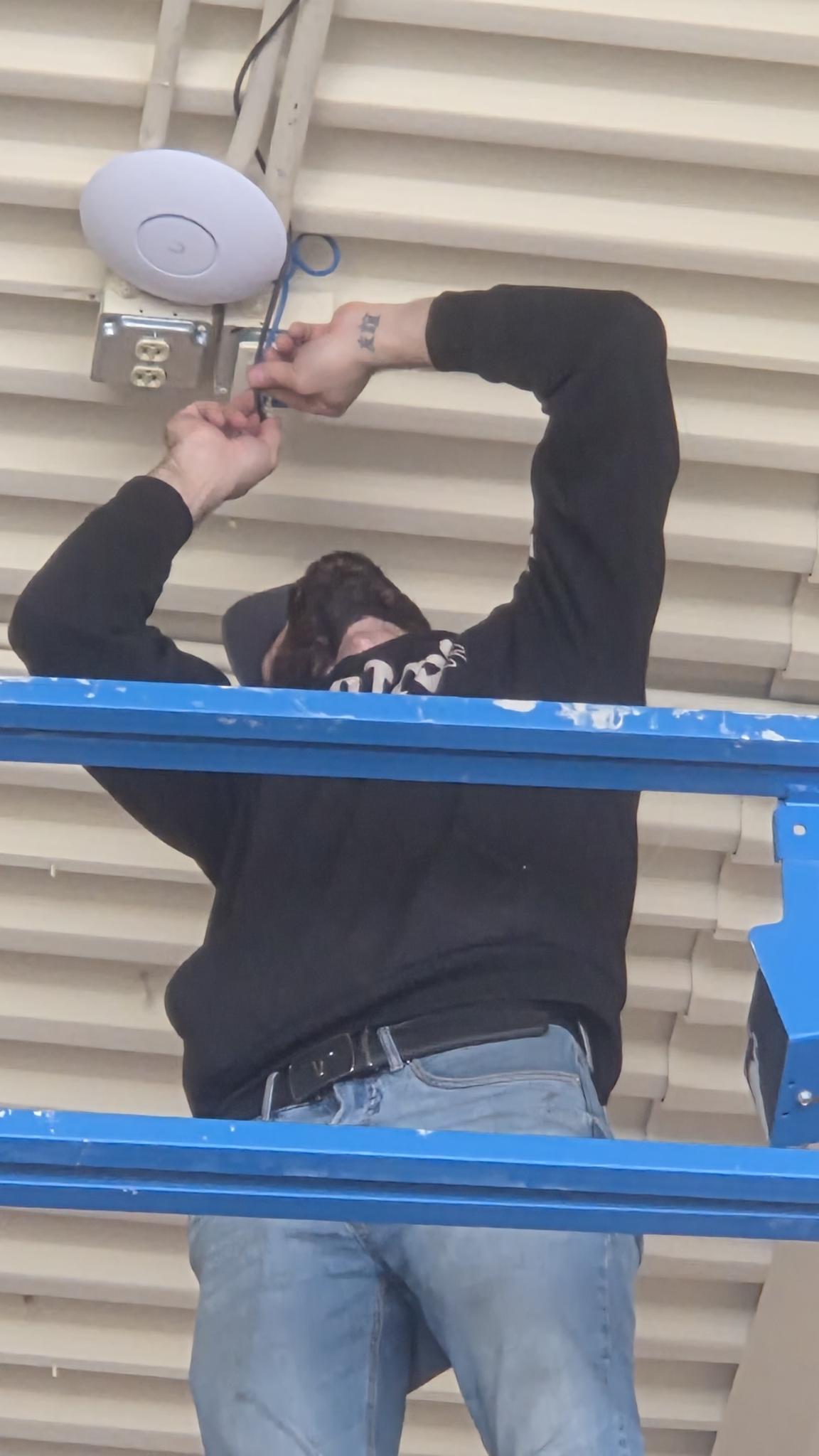
Our crew installed 45 access points and replaced the venue’s switches and routers. We configured VLANs to keep different types of network traffic separate while sharing the same physical infrastructure. At the routing layer, we configured redundant 10-gigabit routers for failover so a second router can take over if the primary router goes offline.

1GC crew installing a Wi-Fi access point at Davis Conference Center
Installing one of the venue’s 45 wireless access points.

A second fiber handoff to UTOPIA

The conference center also needed redundancy where the carrier hands off service to the building. Davis has two fiber uplinks to UTOPIA. 1GC managed the installation of one of those links so the venue could connect through a second handoff instead of depending on a single demarcation point.

Working with the venue beyond the installation

We worked directly with Davis Conference Center staff to address questions and resolve issues that came up during the changeover. The work extended beyond connectivity: we also set up a new cloud server where the conference center could store its data.

For a venue planning a similar upgrade, the network closet is a useful place to start a site survey. The cable serving an access point, the uplink serving its closet, and the routers serving the building each play a different role when a conference fills the rooms.

Bringing fiber to the wall jack at Sugarplum Townhouses in Alta

Salt Lake City and Wasatch Front services

At Sugarplum Townhouses in Alta, Utah, 1GC installed conduit and fiber cabling for a multi-tenant unit (MTU) link to the property’s existing fiber. The finished wall jack is the part a resident or technician sees indoors. Outside, the work followed the concrete wall beside a steel stair and landing.

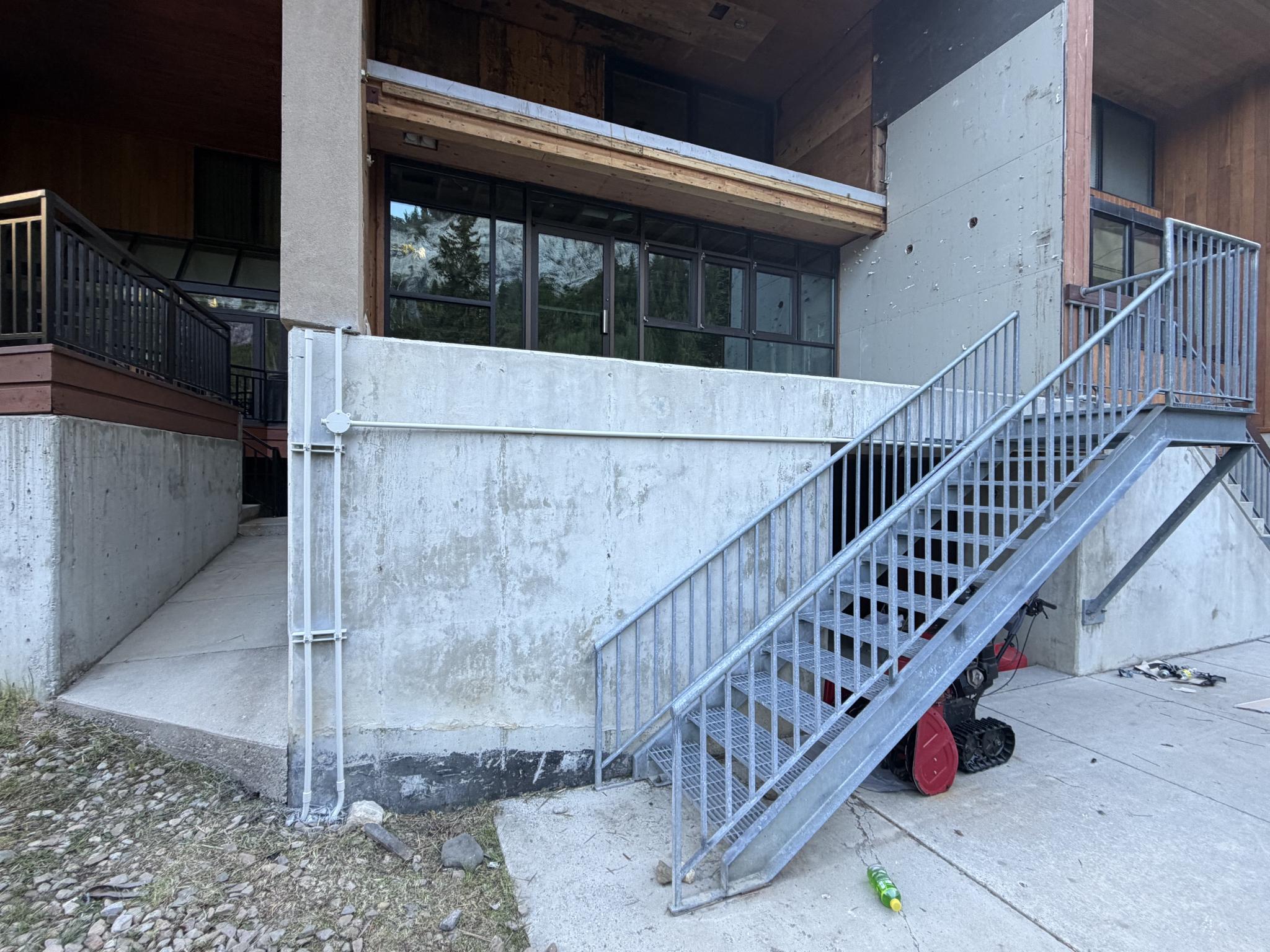
Finished conduit runs along the concrete wall beside an exterior staircase at Sugarplum Townhouses
The finished exterior pathway in Alta, seen from the foot of the stairs.

Building the exterior pathway

The wide view shows where the route fits against the building. During installation, the open junction box gave the crew access to the cable where the horizontal conduit met the vertical run. Once the run was closed, the conduit and fittings protected the cable along the exposed wall.

Installer handling cable at an open round junction box beside the conduit risers
Routing cable at the open junction box.
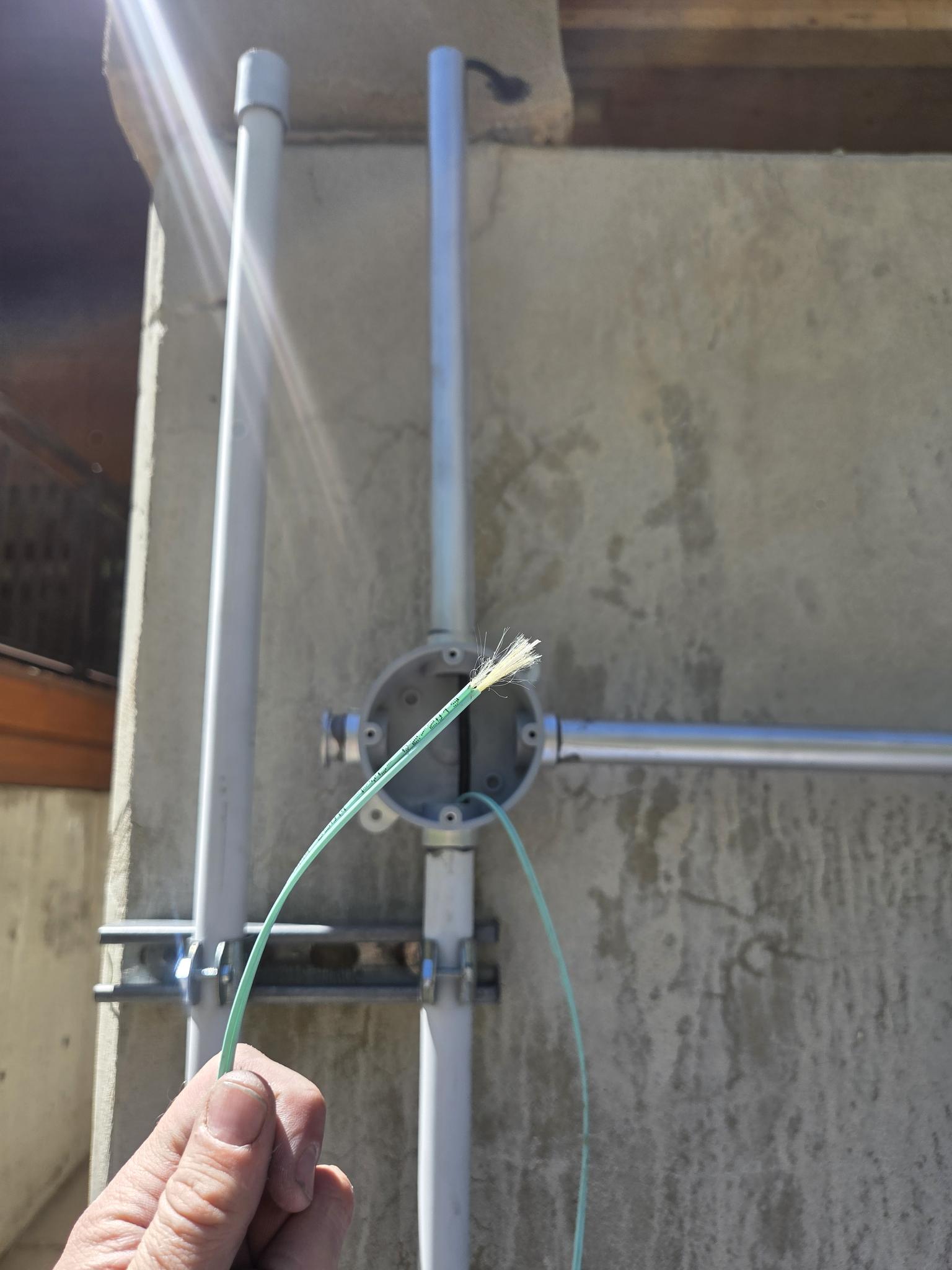
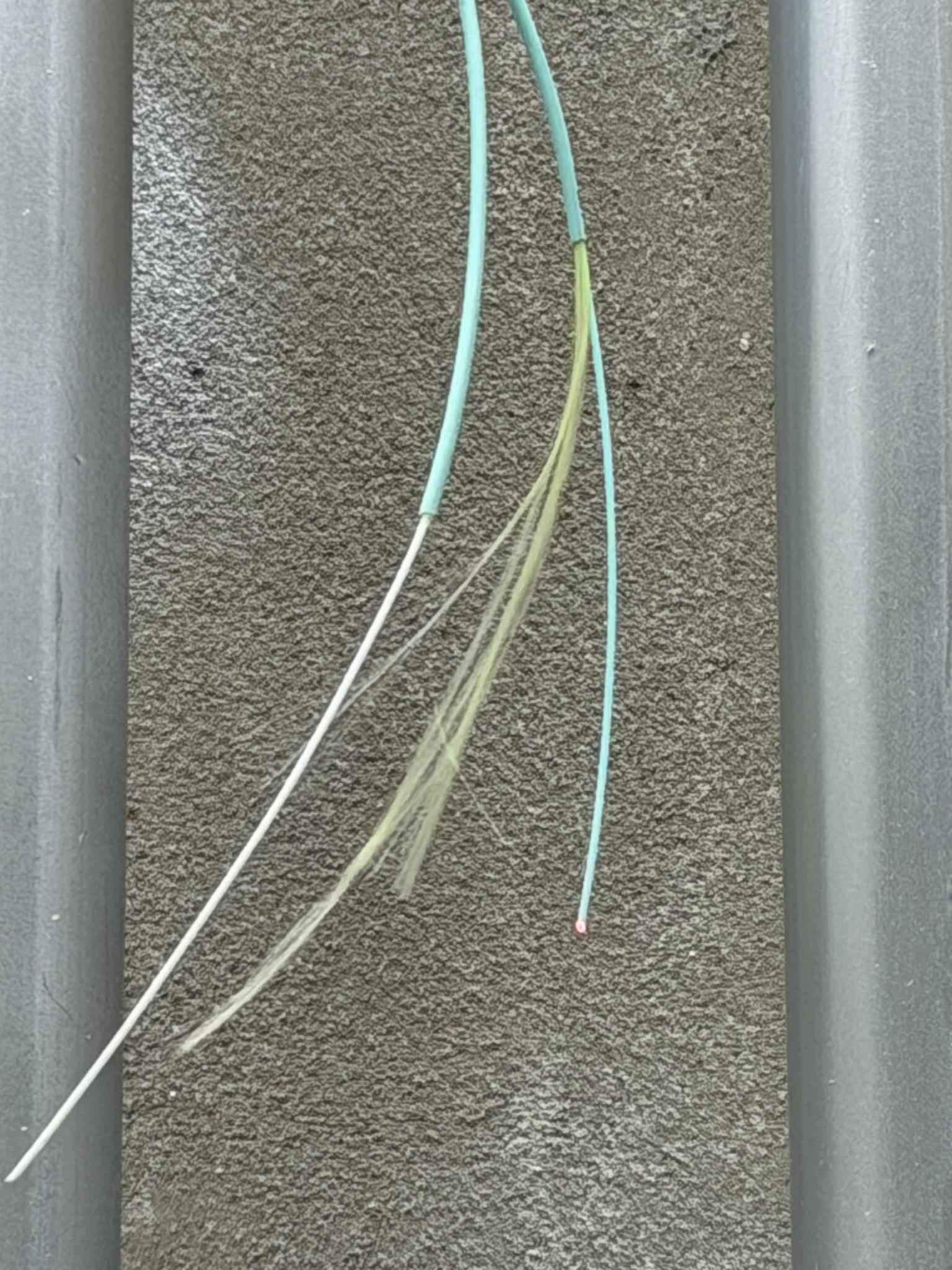
Exposed end of the fiber cable beside metal conduit during preparation
The cable during preparation for termination.

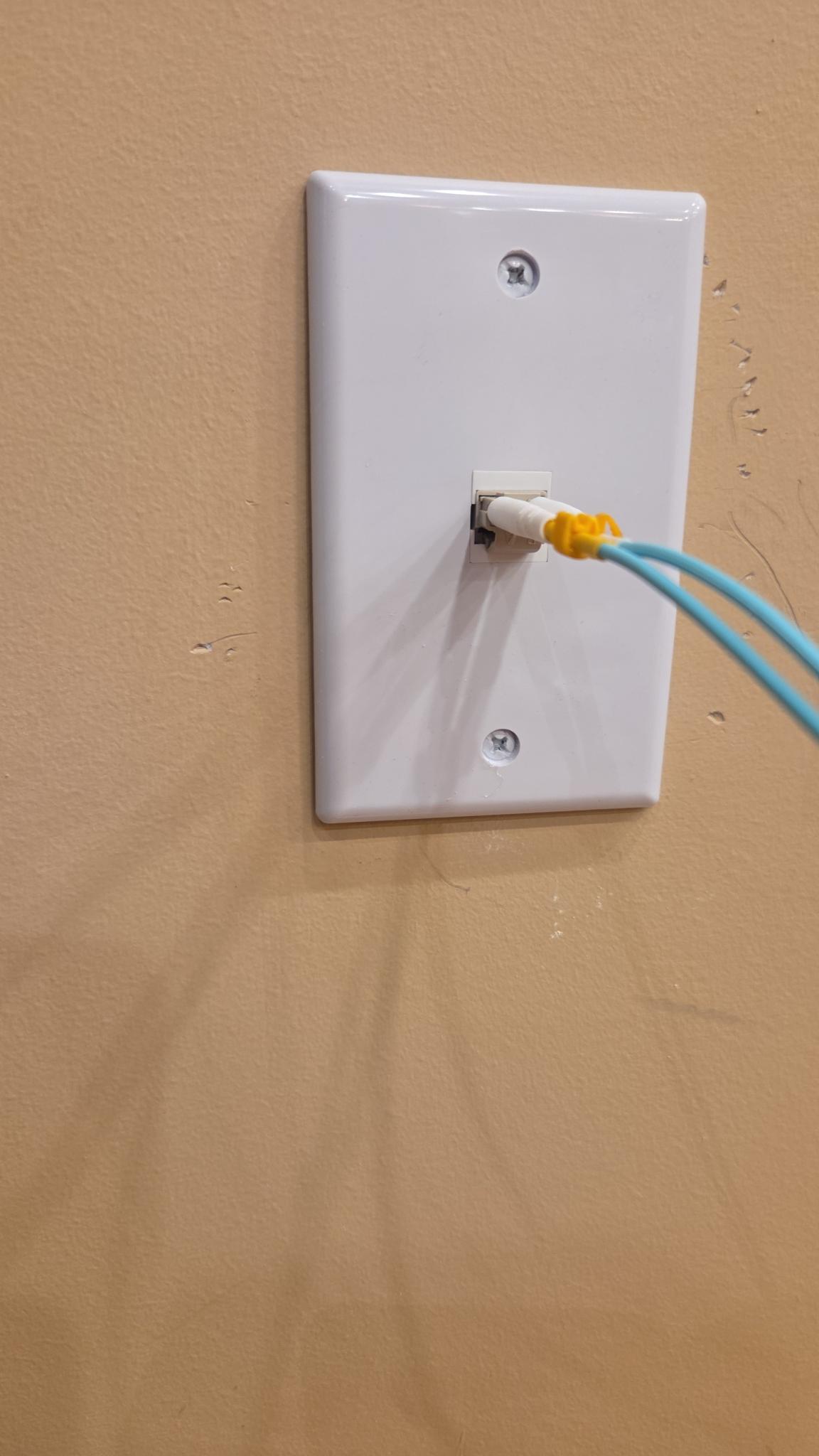
The finished fiber jack and demarcation router

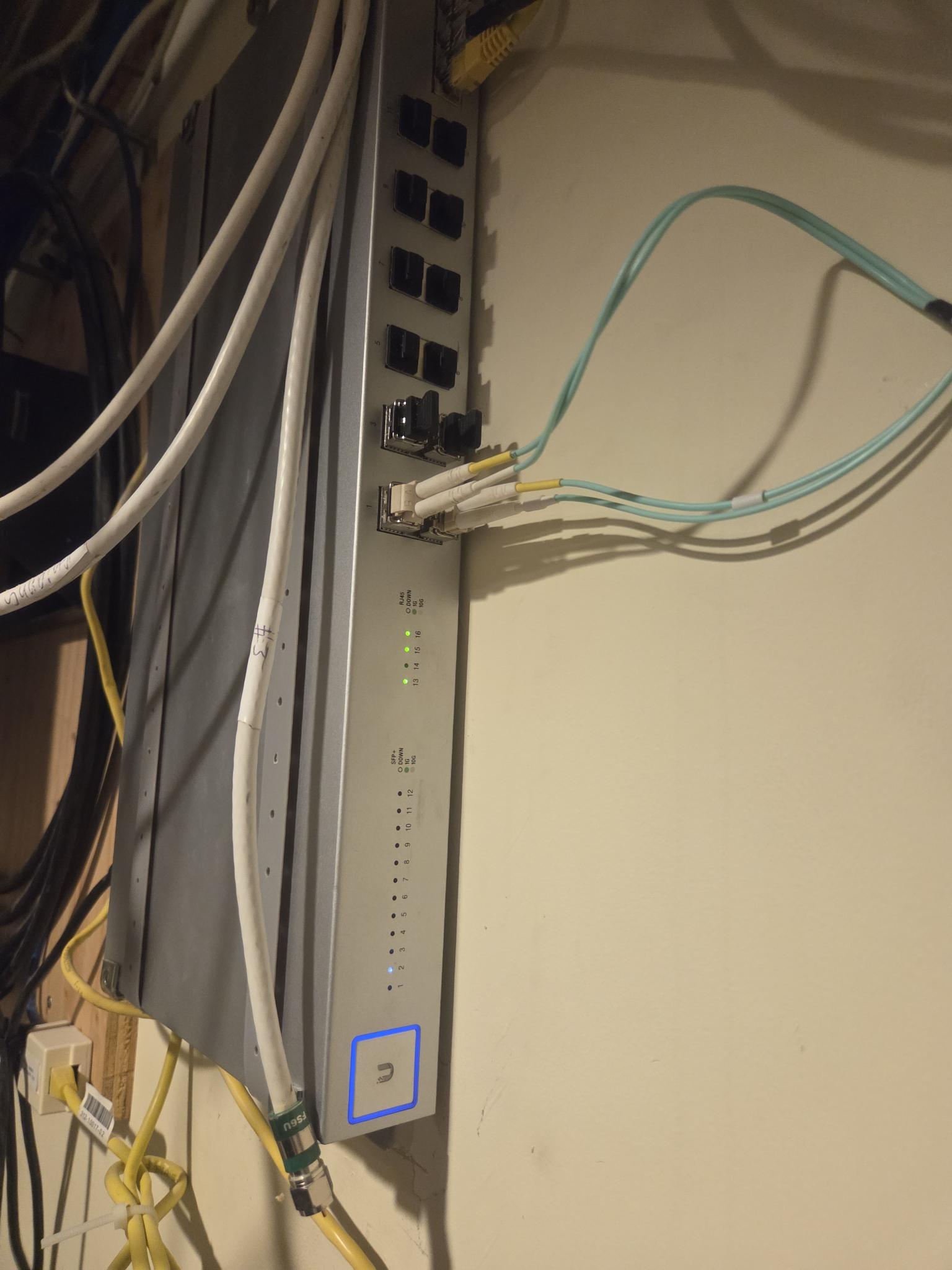
Inside, the fiber terminates at a wall plate that accepts a patch lead. The demarcation router is the network equipment at the handoff. Together, the photos show the difference between the installed building cabling, the replaceable patch lead and the equipment the link serves.

Fiber patch lead plugged into the finished white wall jack
The finished fiber jack.
Demarcation router with fiber patch leads connected
The demarcation router at the property.

Planning a fiber link for a multi-tenant property?

Start with three points on the plan: the existing fiber handoff, the proposed jack location and the pathway between them. A photo of the equipment room and a view of the exterior route help us assess where new conduit may be needed.

Request a site survey

12 cameras and a fiber demarc extension for a Salt Lake City warehouse

At this Salt Lake City warehouse, 1GC installed twelve cameras, ran structured cabling, extended the carrier’s fiber handoff and installed a network rack with Cisco hardware. The work took the crew from a lift outside the loading door to the equipment rack inside.

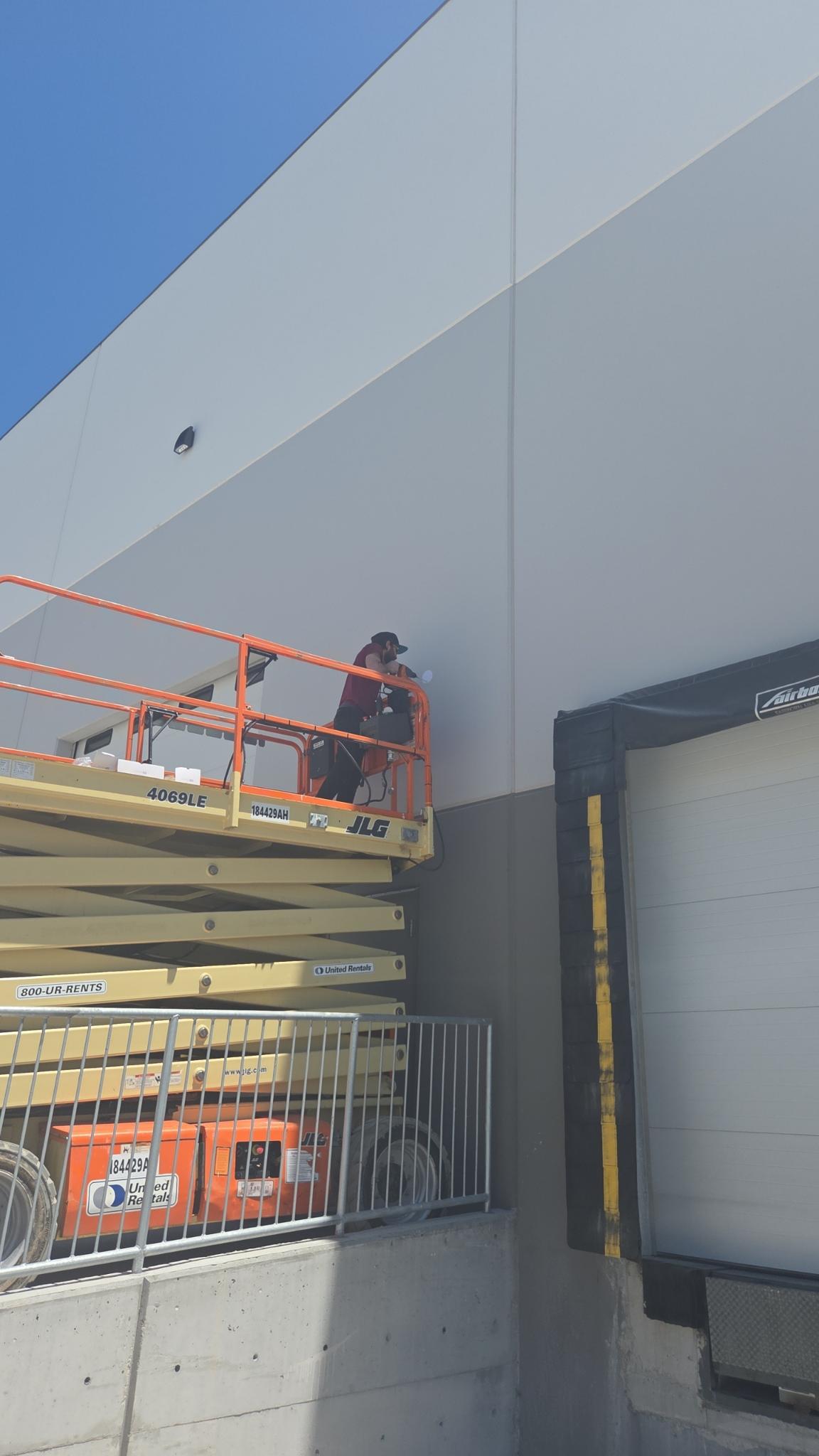
Exterior lift work beside the warehouse loading door

Reaching the camera locations

Our installers used lifts to reach elevated mounting locations. The installation included cameras on interior steelwork and on the exterior wall. The wide view shows the height of the work area. The close-up shows one of the twelve cameras after installation.

Finished exterior camera
A 1GC technician works from a scissor lift at the warehouse exterior.

Extending the fiber handoff

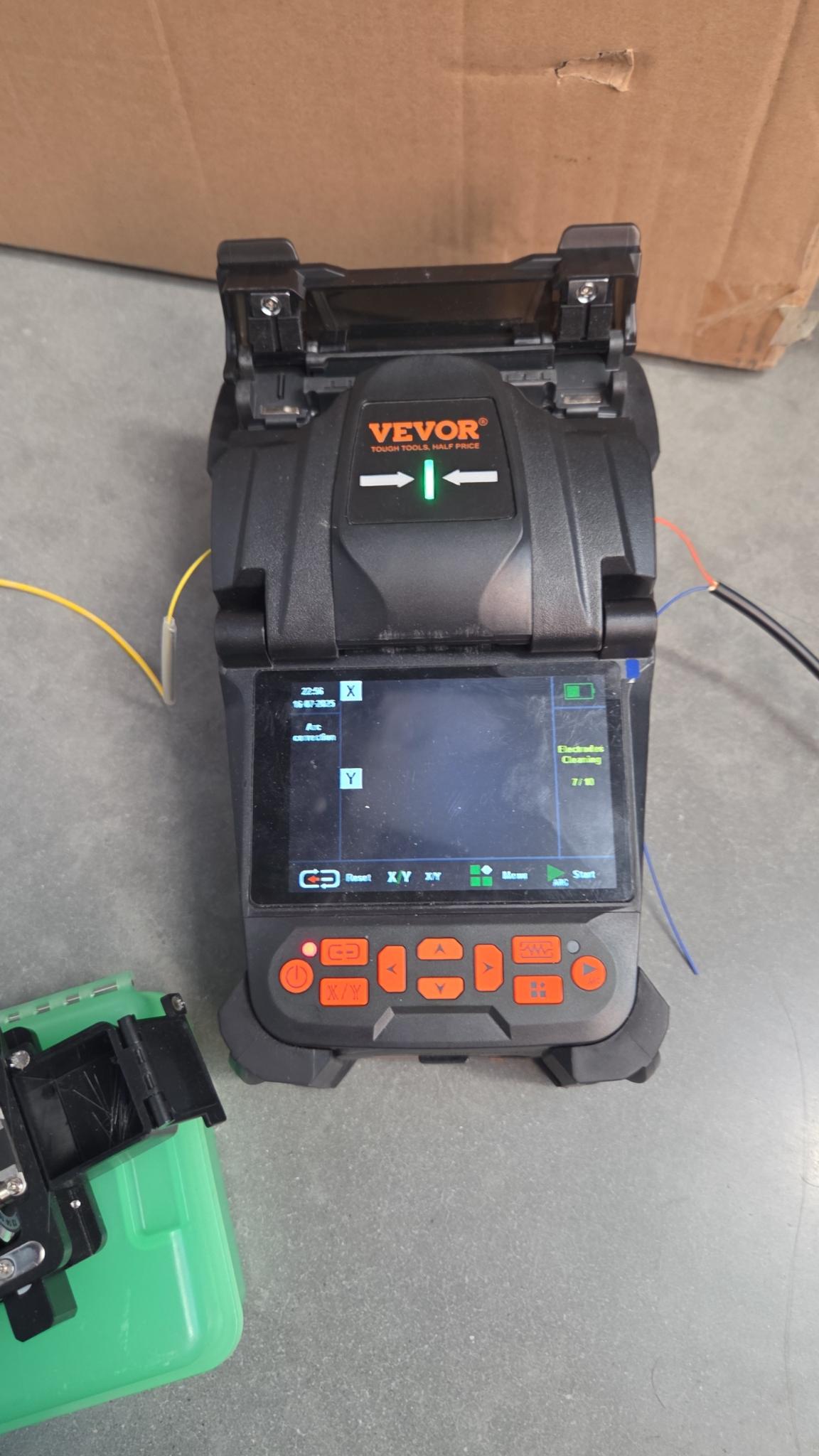
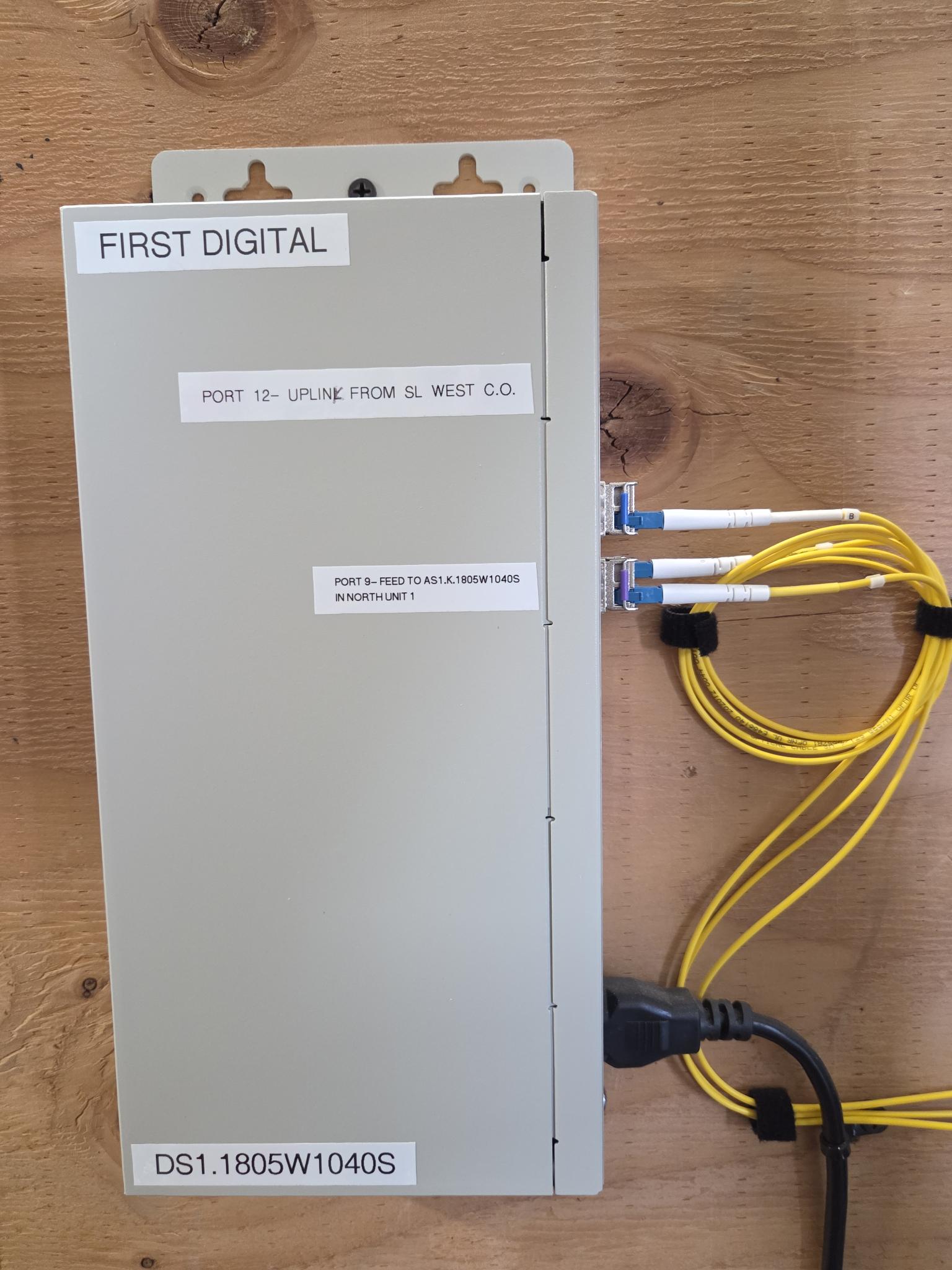
The demarcation point is where the carrier hands off service. Our crew ran, spliced and terminated fiber to extend that handoff farther into the building. These two views show the equipment used to join the fiber and the patch leads at the carrier enclosure.

Fusion splicer and tools on site
Carrier fiber enclosure and patch leads
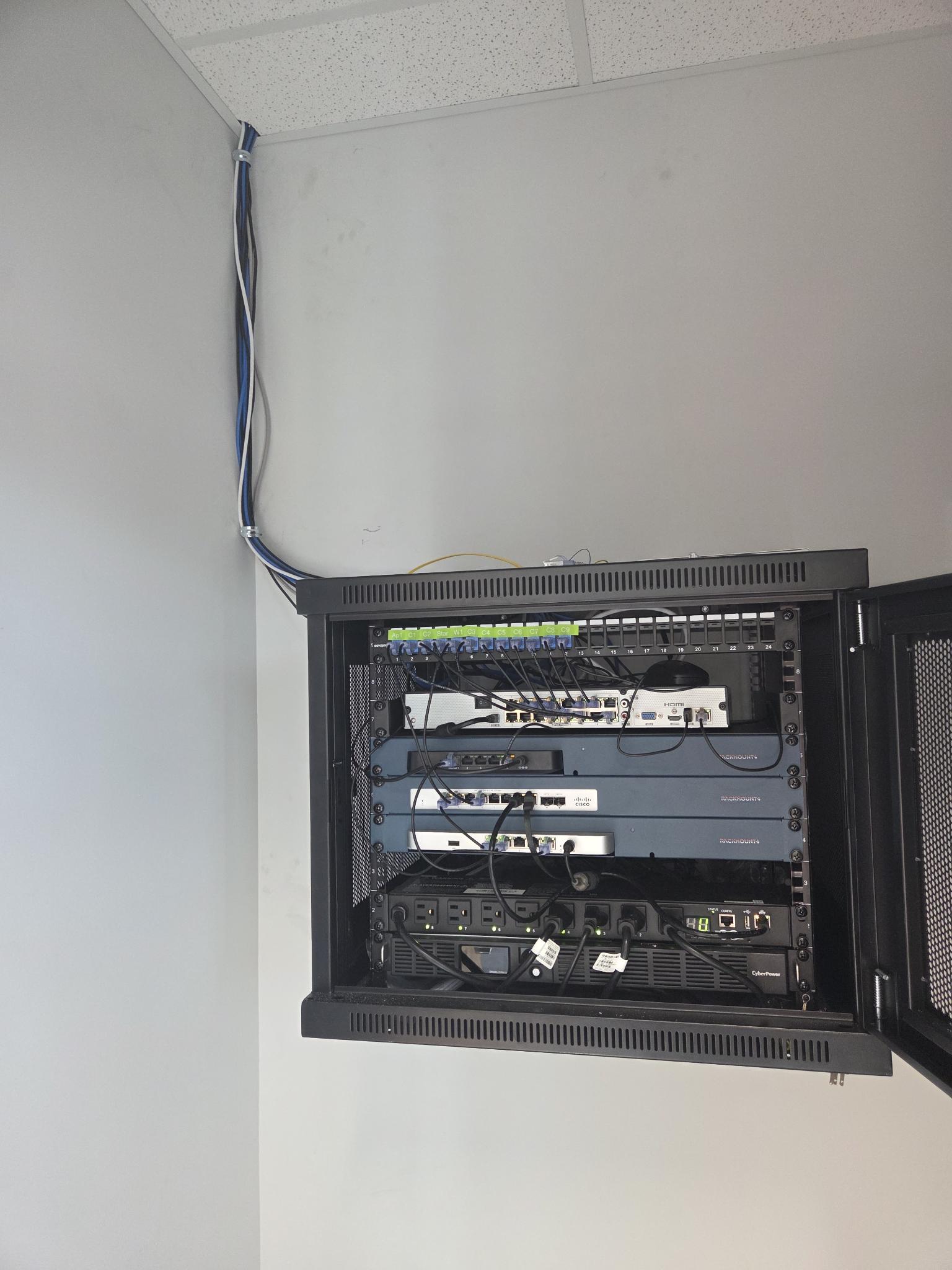
Installed wall rack with network equipment

Installing the network rack

Our scope also included the wall-mounted rack and Cisco network hardware. The open cabinet shows the patching and equipment behind the warehouse installation.

Request a site survey for your building

Behind the walls at Margulis Gelfand DiRuzzo & Lambson: a St. Louis law office installation

When Margulis Gelfand DiRuzzo & Lambson bought a St. Louis metro office building dating to the 1950s, the firm took on a whole-building remodel. It hired 1GC to handle the information technology from start to finish. Our construction crew opened walls so our datacom team could rebuild the cabling throughout the property. Once the Cat 6A runs were in place, we patched and painted the walls.

Those routes connected offices, six Wi-Fi 7 access points, cameras and facial-recognition access control at two doors. They also served two conference rooms with different audiovisual systems. The photos follow the crews from the first cable pulls to the spaces the attorneys use each day.

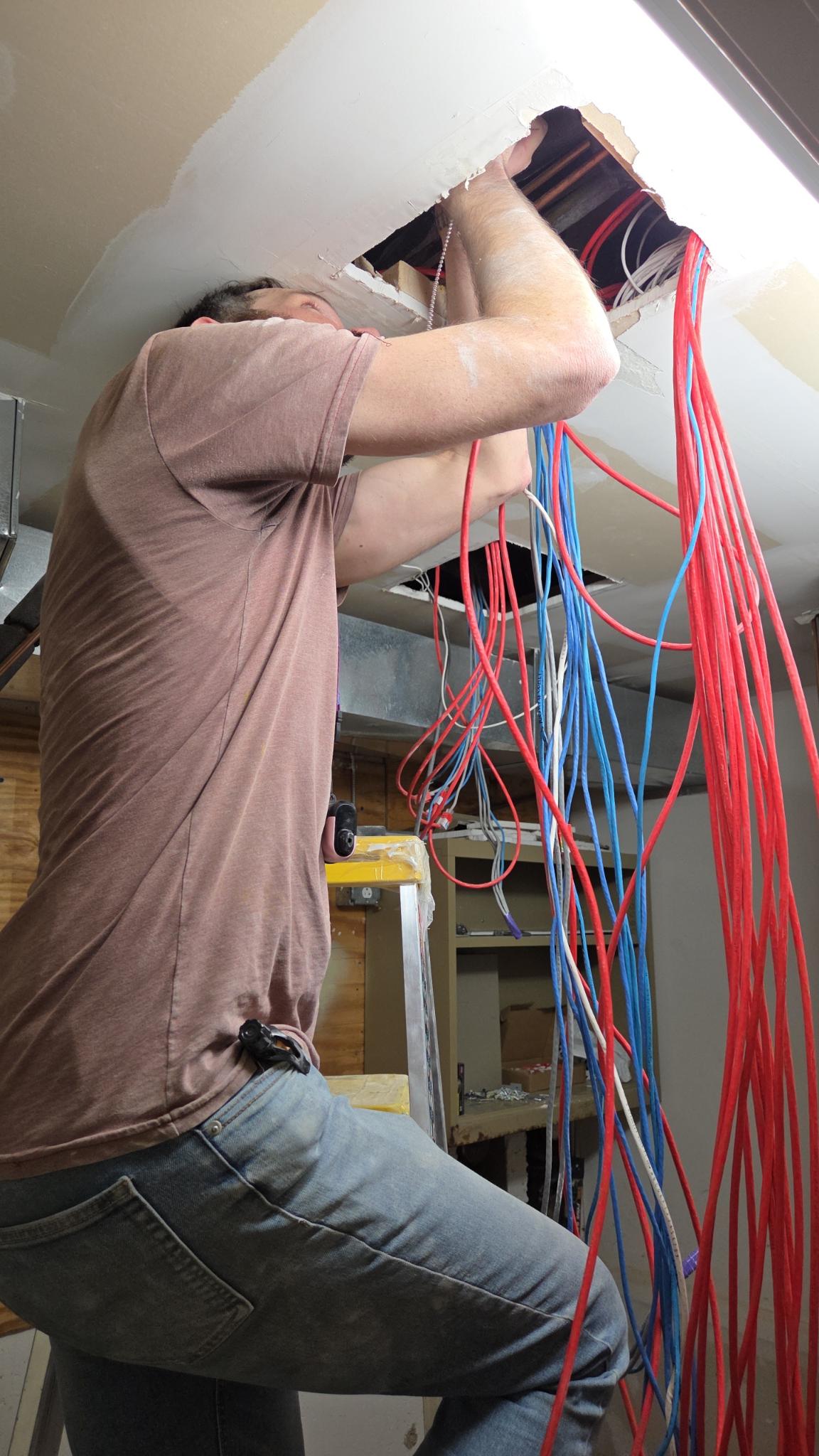
Technician pulling bundled cable overhead
A 1GC technician gathers the Cat 6A runs at the ceiling opening.

Starting with the path into the building

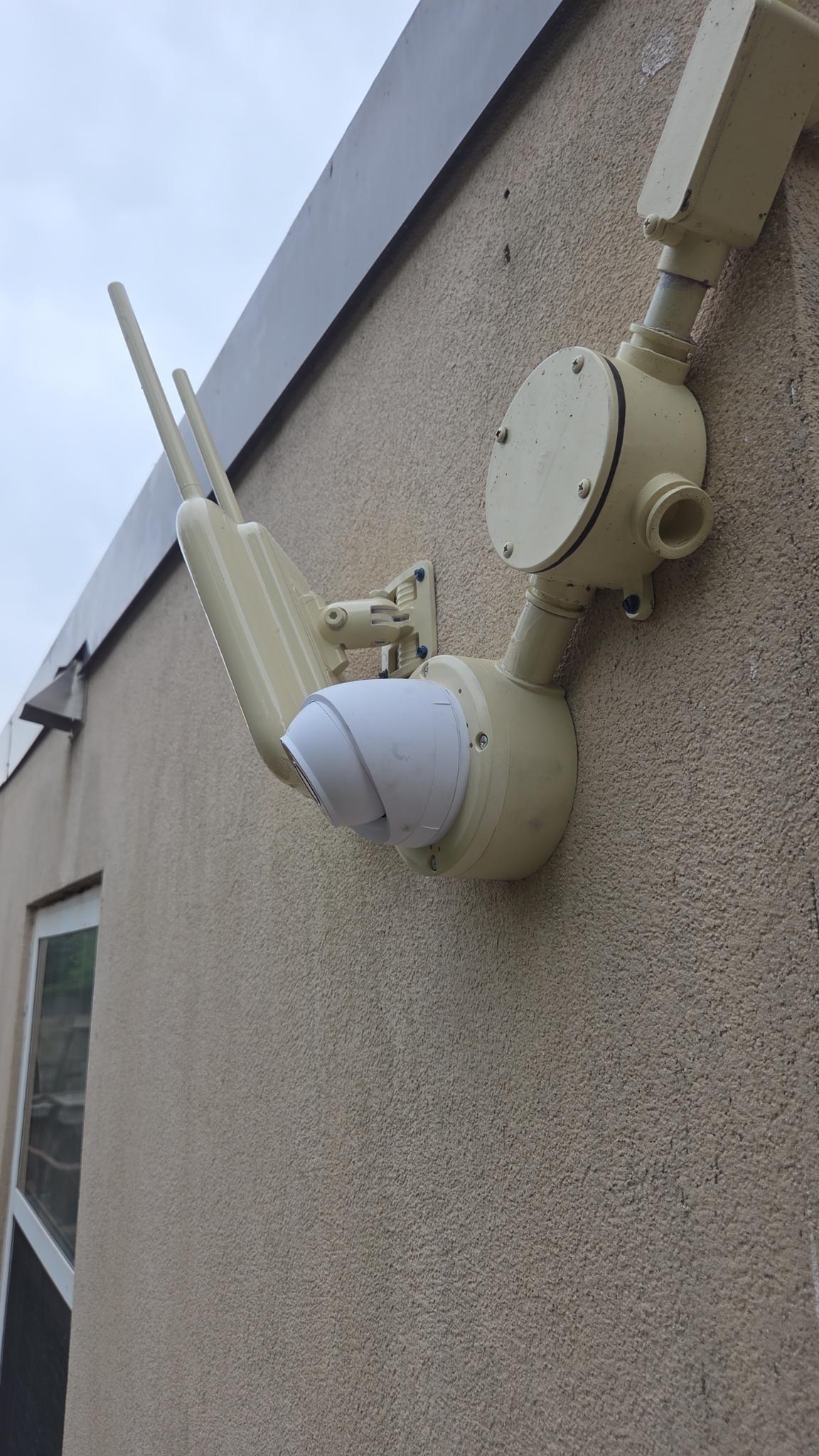
Outside, we installed conduit for AT&T’s fiber entrance, along with exterior pathways for Wi-Fi and cameras. The carrier entrance and the office network had different jobs. The conduit gave the carrier a route inside. The building cabling carried the network from the equipment rack to the places the firm needed service.

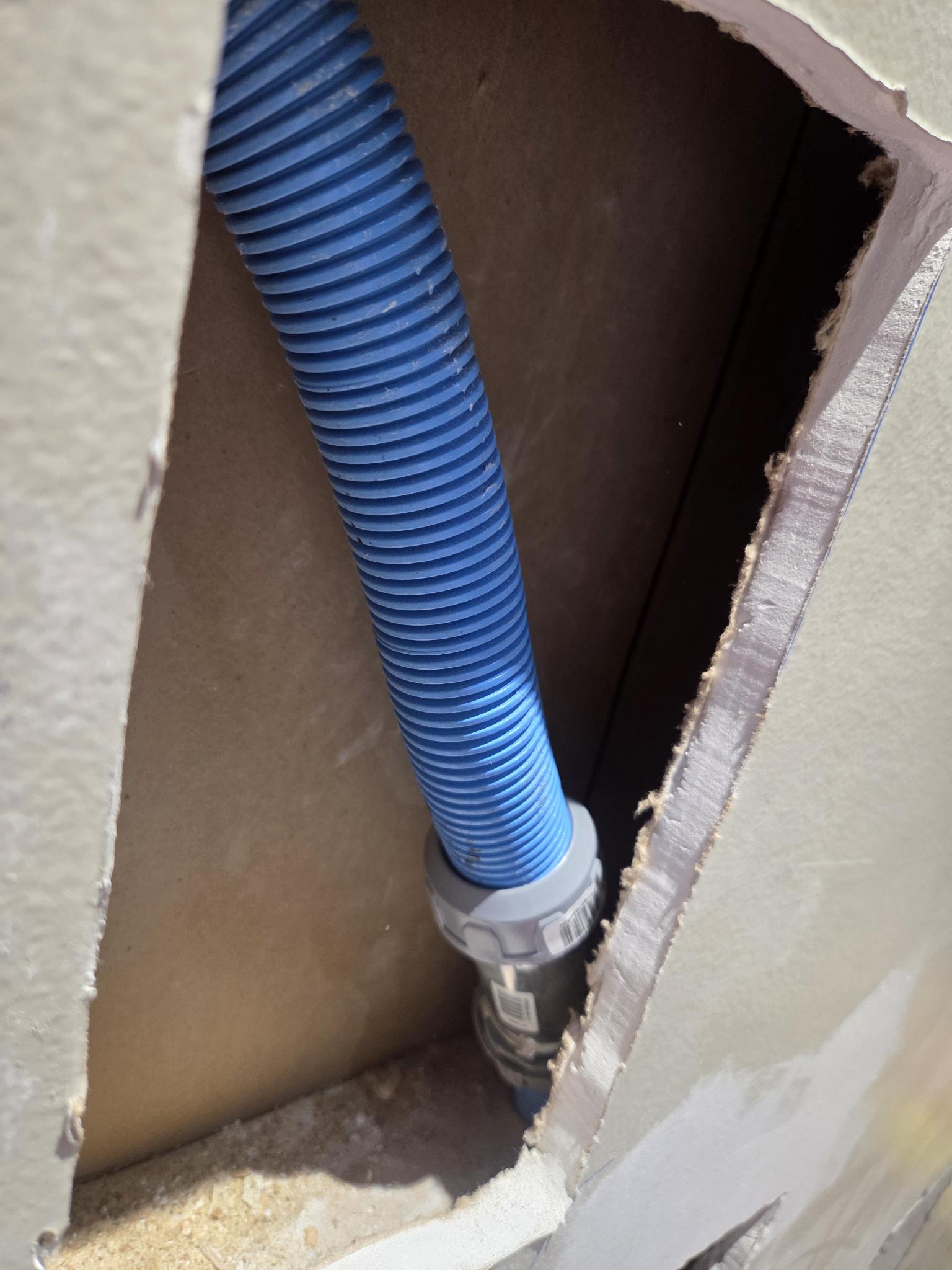
Inside, the rough-in photos show cable drops beside open studs, flexible conduit in a wall cavity and openings for devices. At this stage, a cable end can still be moved before a wall closes. By the time the wall is patched and painted, the location of that opening determines where the finished jack or device sits.

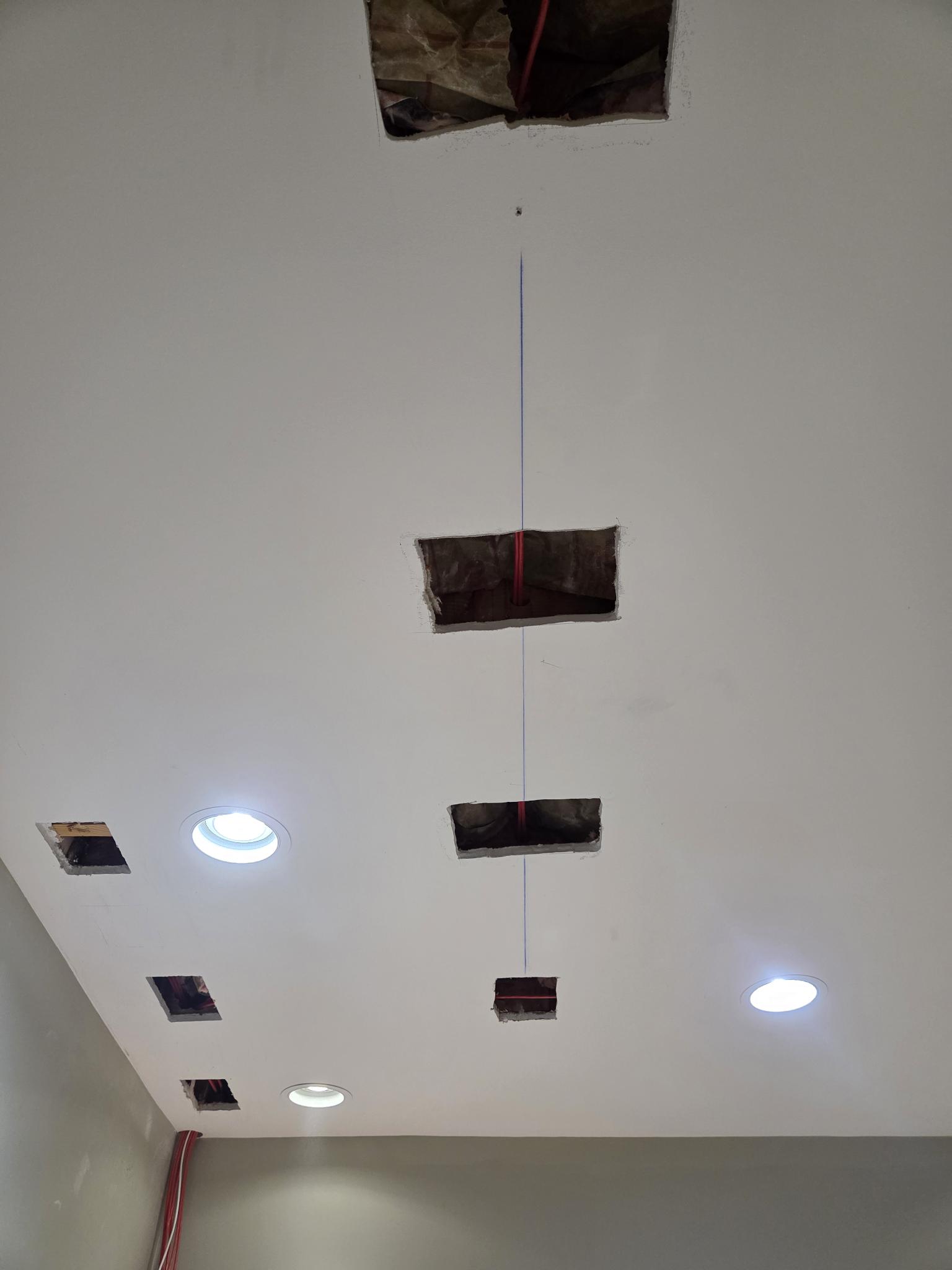
Ceiling openings along cable route
The ceiling openings follow the route the crew needed to reach.
Blue flexible conduit inside wall
Flexible conduit protects the route through the wall cavity.
Exterior device and round junction boxes
Exterior conduit and junction boxes at a mounted device.

From the rack to every office

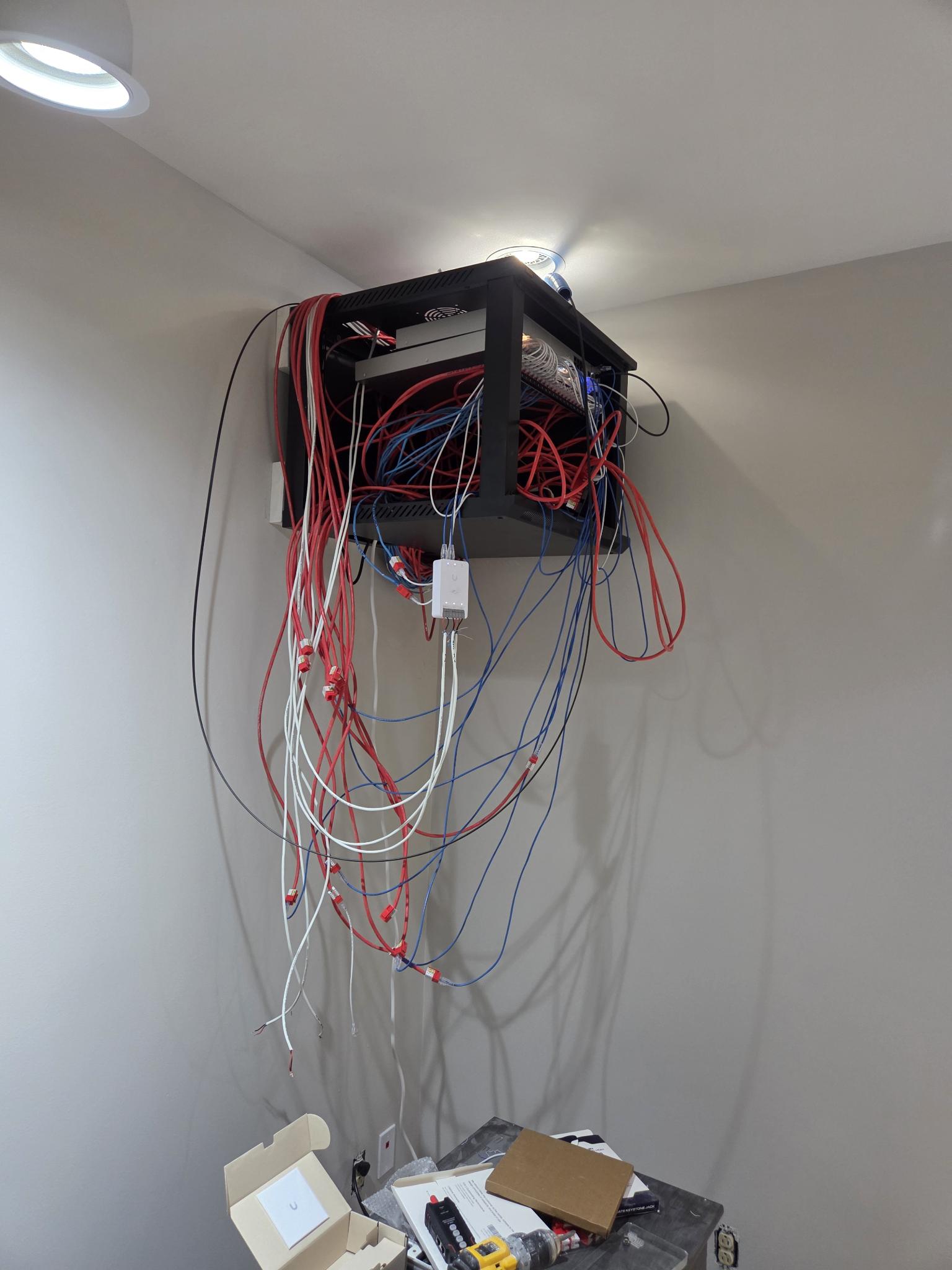
We installed the network rack, switch and router and ran Cat 6A to jacks in every office and to each access point. Each ceiling-mounted Wi-Fi 7 access point has a wired route back to the switch. The finished access point is a small part of what had to be installed to bring wireless service into the room.

Wall rack during cable installation
The rack during rough-in, before the cables were dressed.
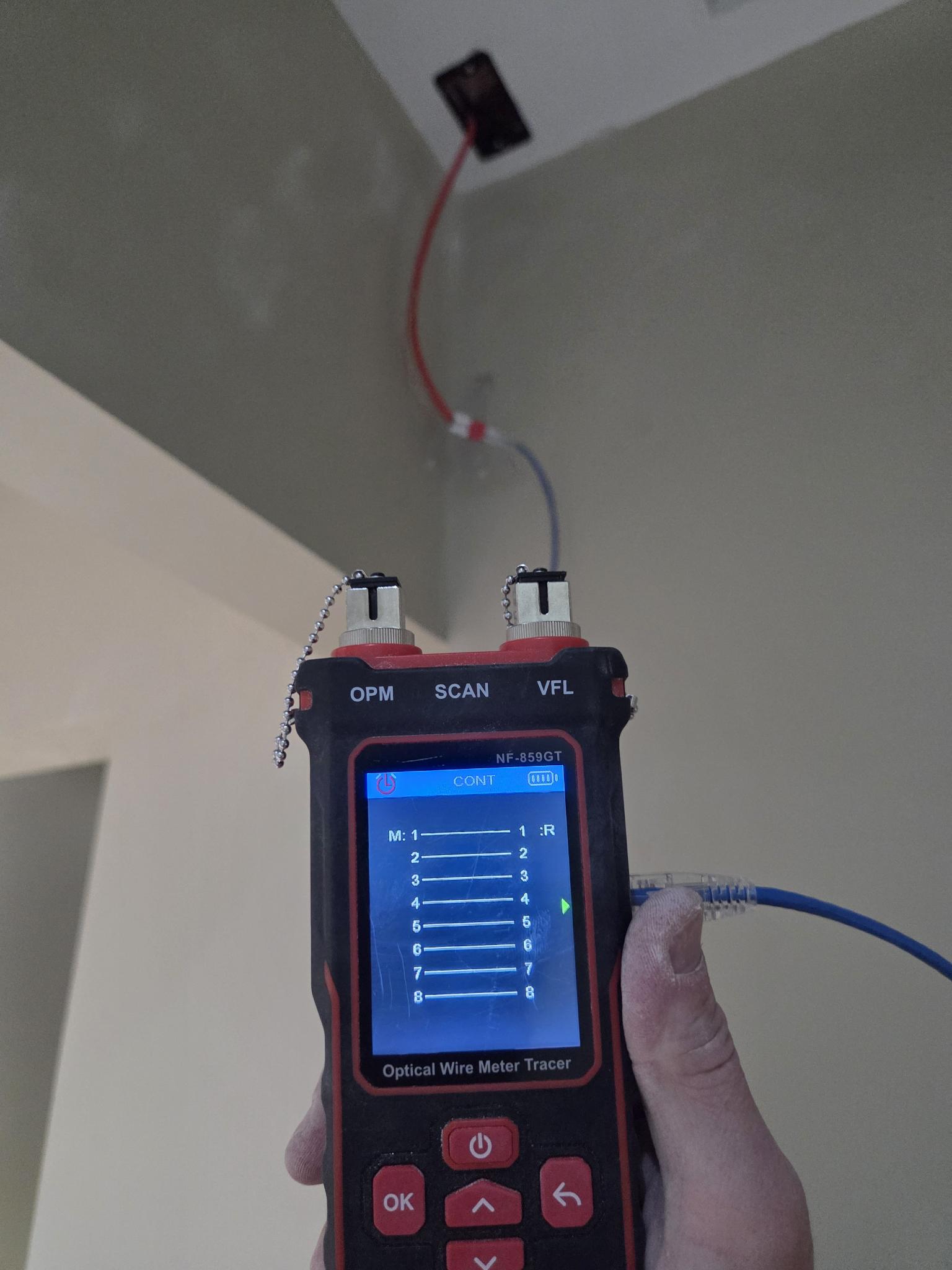
Handheld cable tester at ceiling drop
Checking the office cable run with a handheld tester.
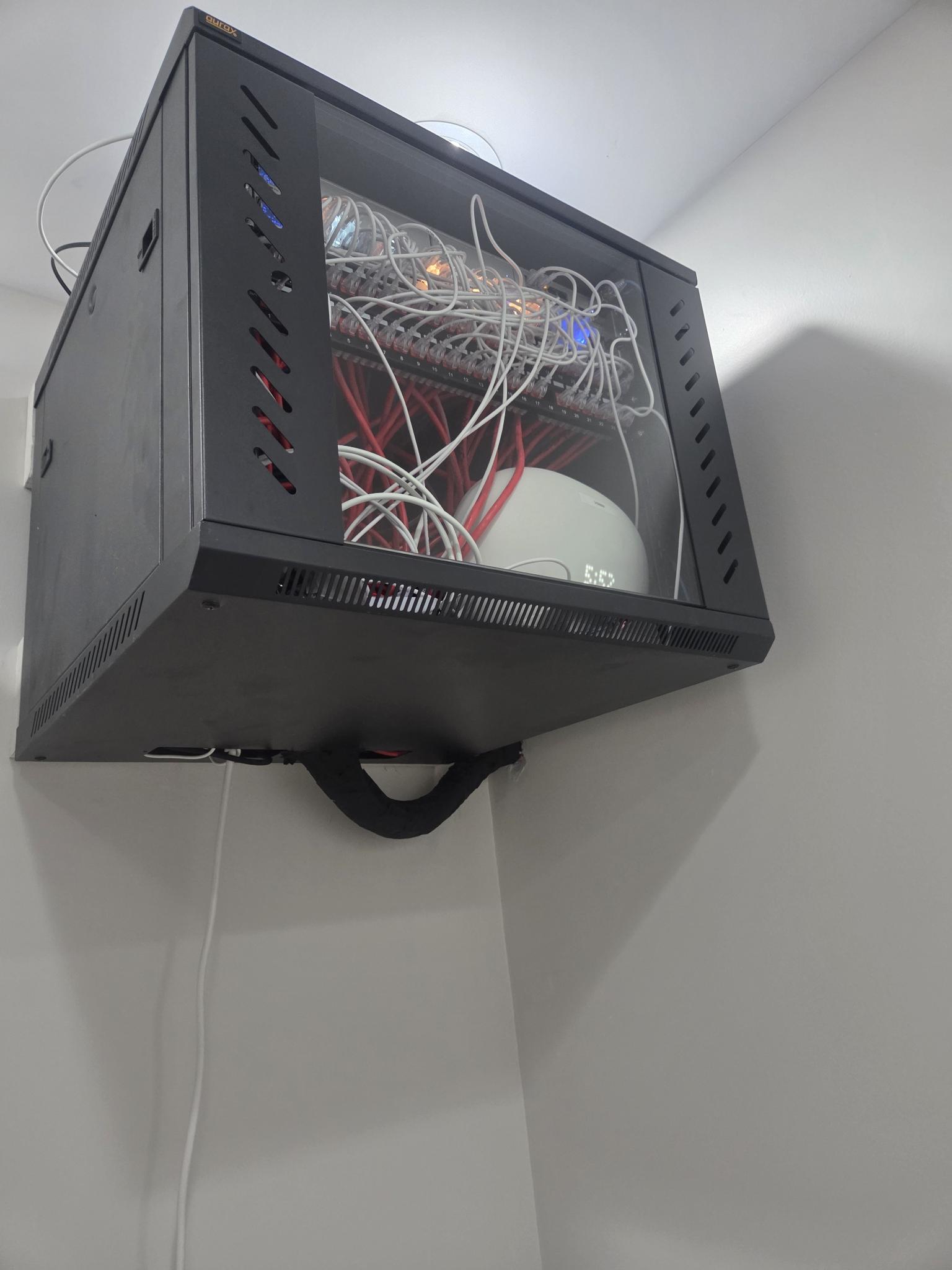
Wall-mounted cabinet containing the law firm’s network equipment
The network rack houses the equipment serving the office cabling.
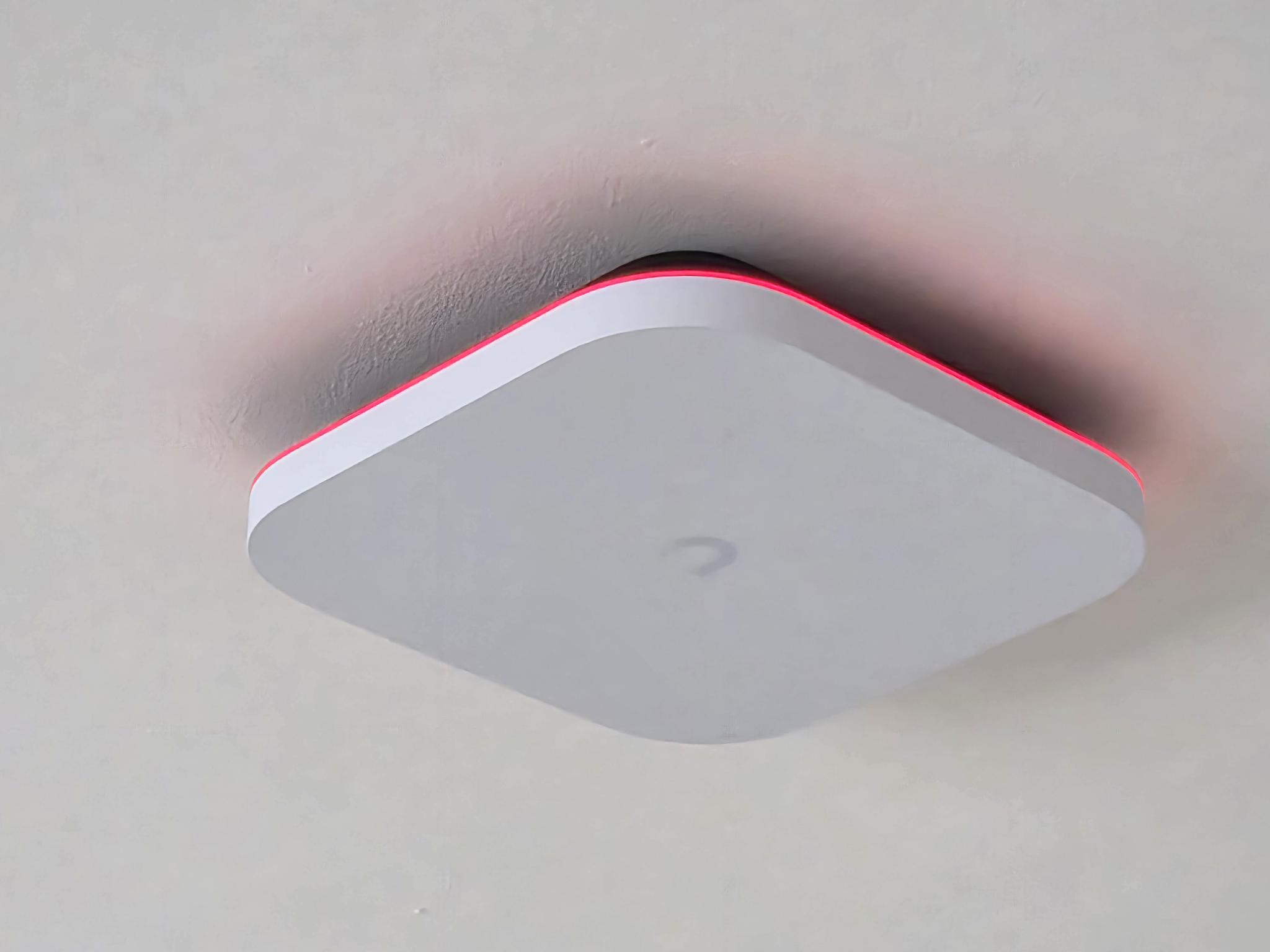
Installed wireless access point on the finished ceiling
One of the finished ceiling access points on the firm’s Wi-Fi 7 network.

Fitting access control to two doors

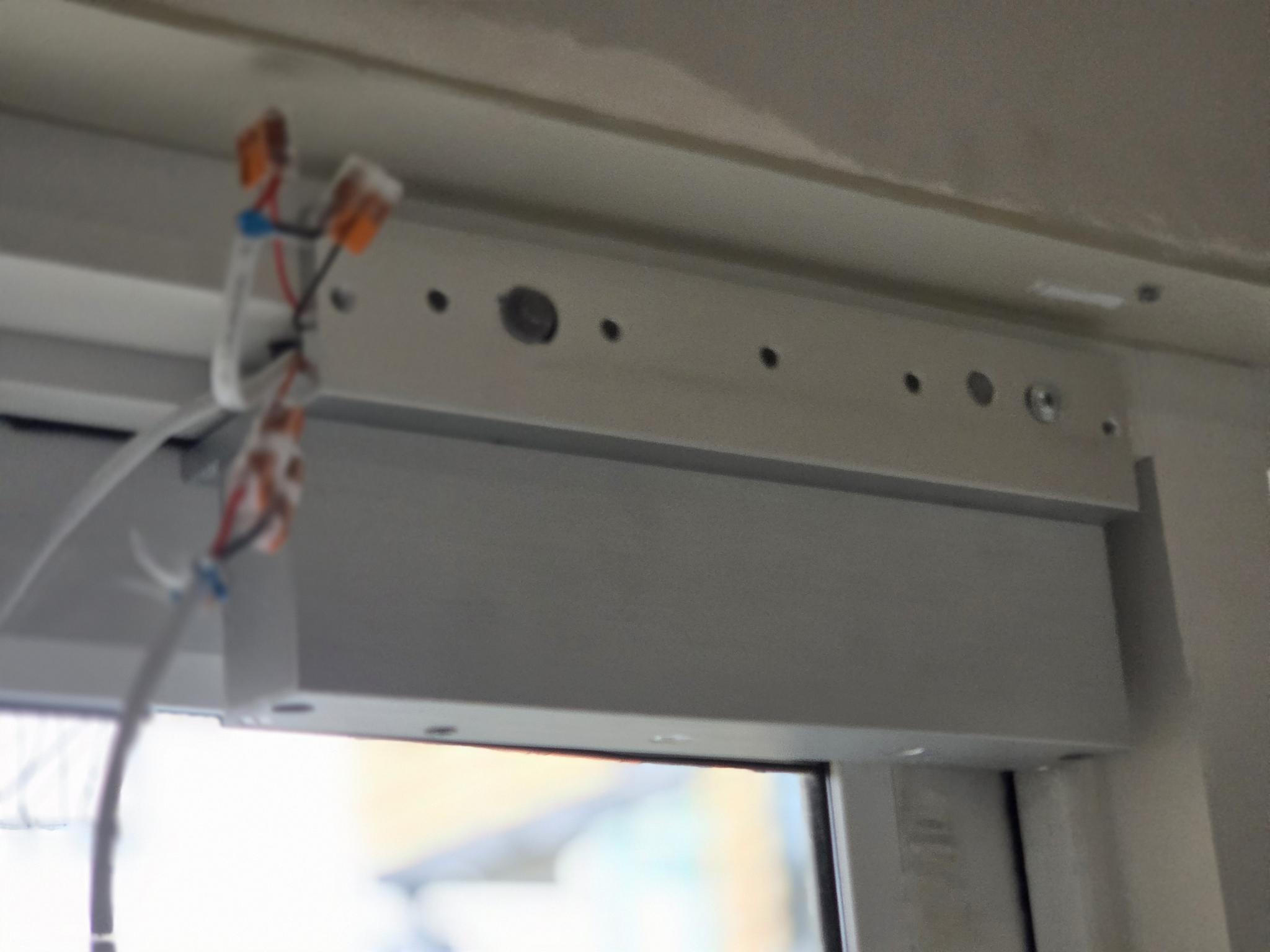
The firm’s installation included facial-recognition access control for two doors and a camera system. The work-in-progress views show the door frame before the header hardware was closed up. Our installers fitted mounting plates, routed wiring into the frame and made the connections that the finished hardware conceals. Wall repair and paint were part of bringing the surrounding office back to a finished condition.

Door header wiring connectors
Access-control wiring at the door header before close-up.
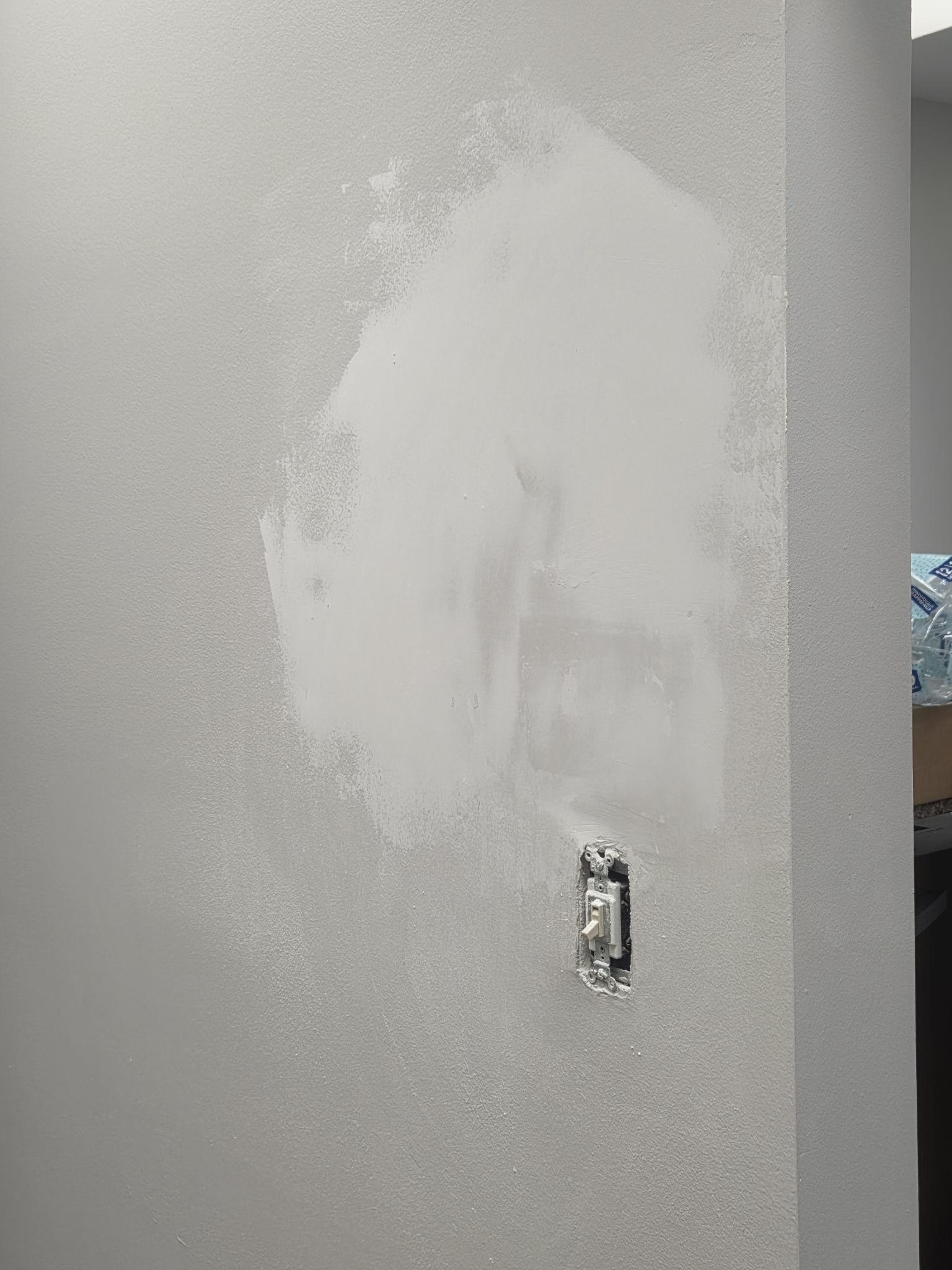
Patched wall around device opening
Wall repair around the device opening before final paint.
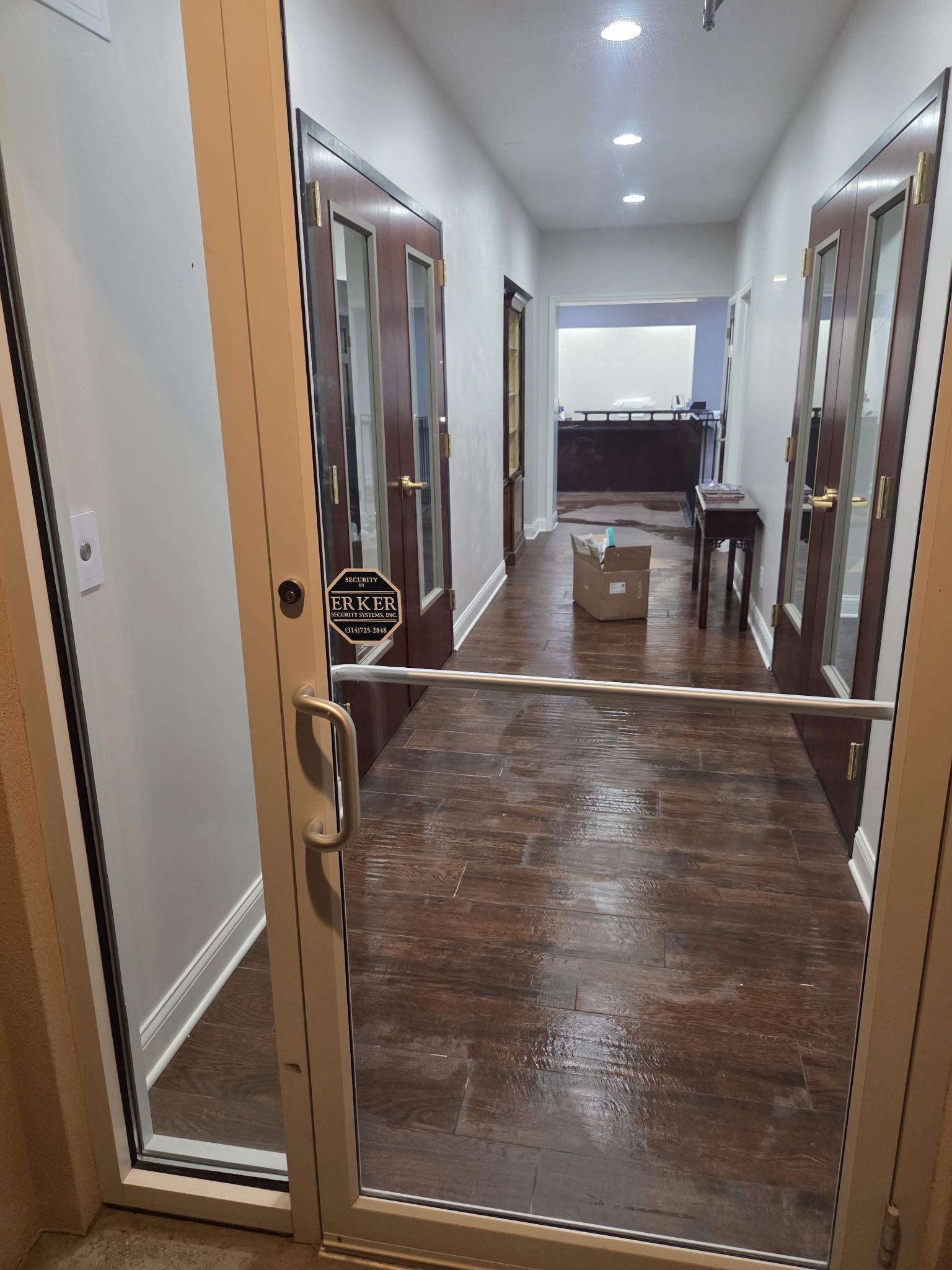
Glass entry door and access hardware
The finished glass entry with its access hardware in place.

AV installation in two conference rooms

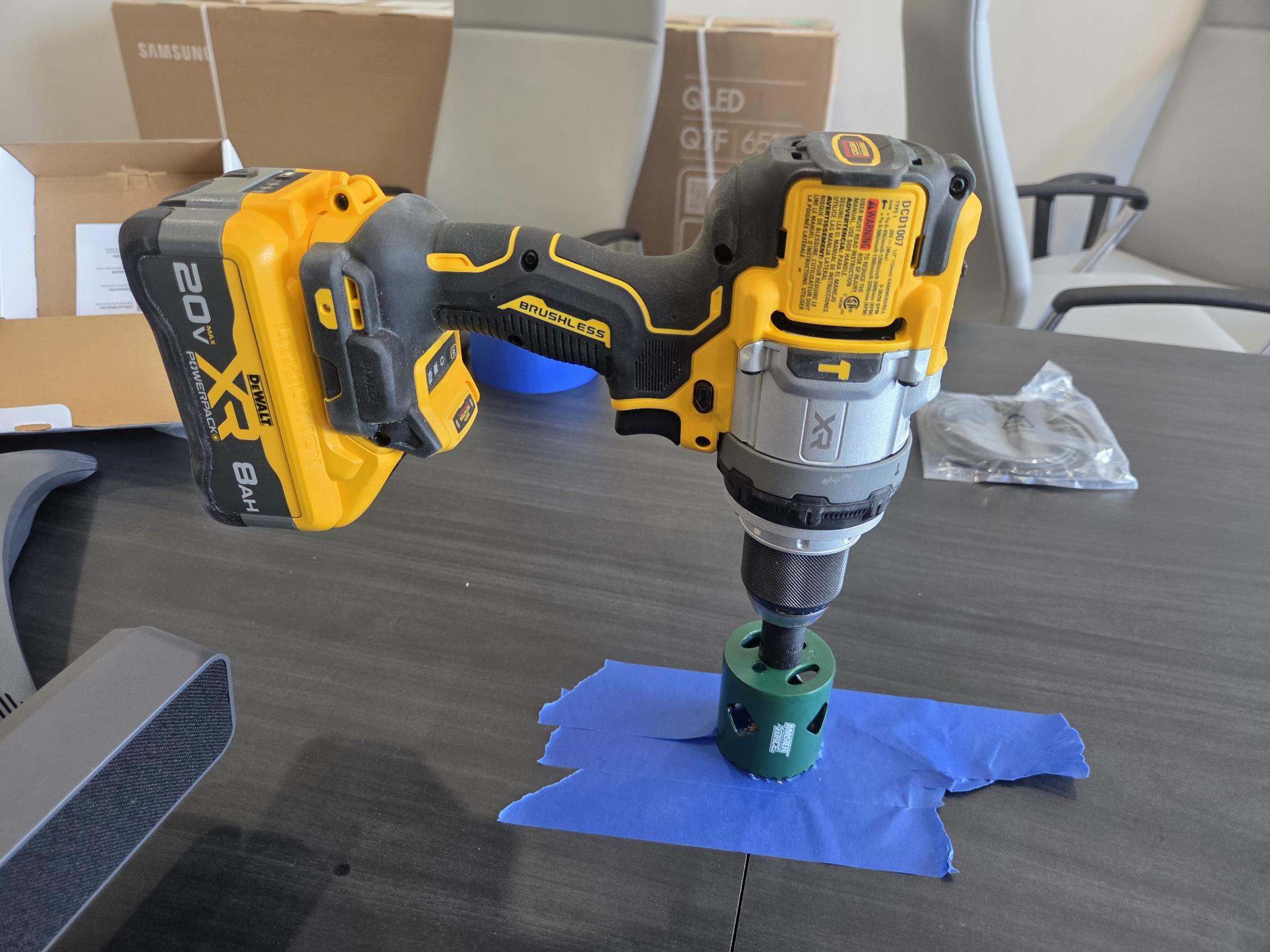
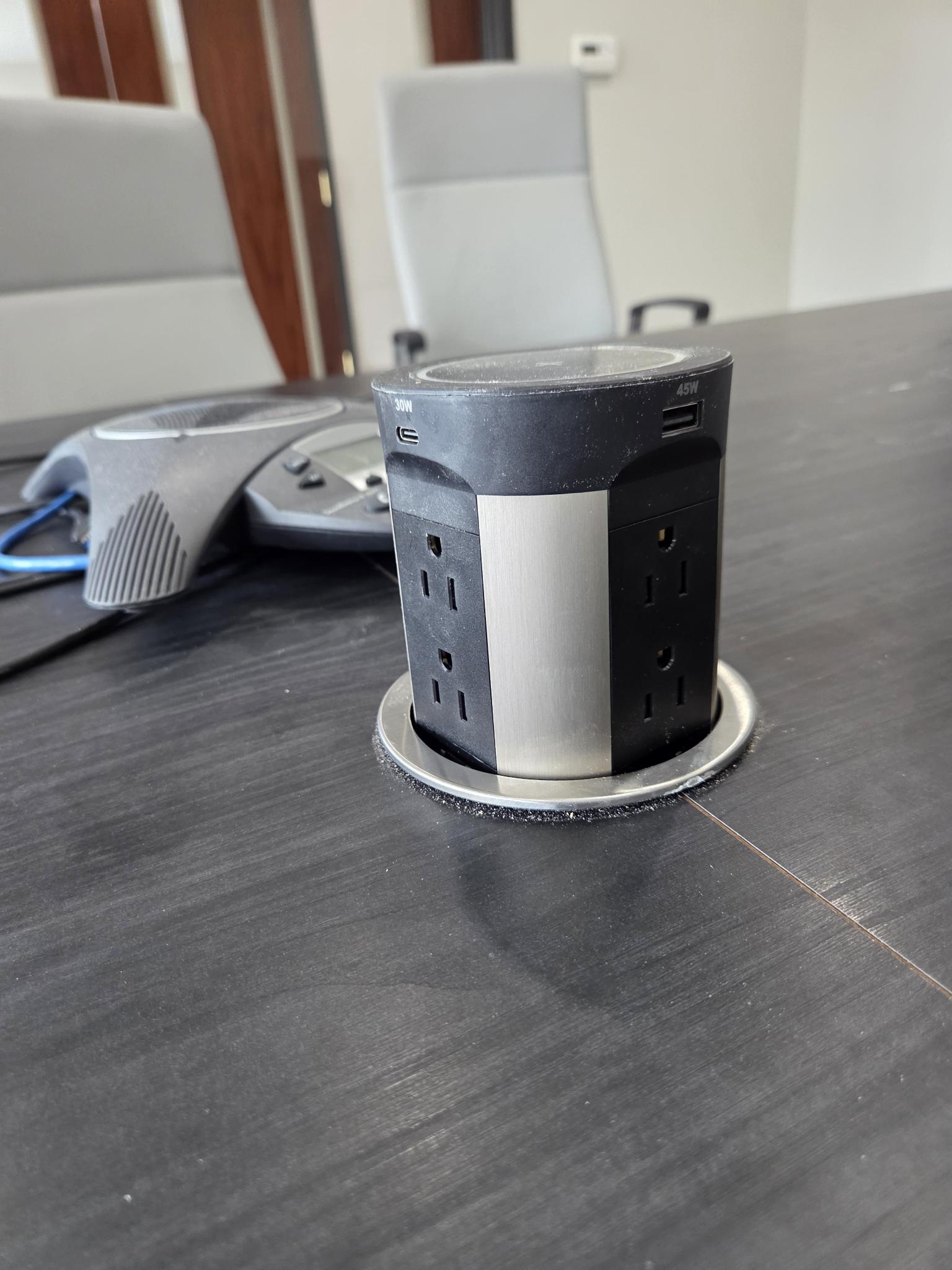
We installed an LG TV with an L bar in one conference room. In the second room, we mounted two new Samsung TVs and configured an AV Access system for video conferencing and casting to both TVs. The table needed power within reach of the people using it. The installation sequence shows the tabletop marked for the cut, the circular opening drilled and the pop-up power module seated in that opening. Those details are easy to overlook in a finished-room photo. They matter every time someone arrives for a meeting with a laptop.

Drilling the taped conference tabletop
Cutting the opening for the conference table’s power module.
Conference table pop-up power module
The pop-up module brings power to the tabletop.
Wall-mounted TV during setup
A wall-mounted display during setup.
Two Samsung displays with a conference camera centered beneath them at the end of the meeting table
In the finished conference room, the firm can hold video meetings or cast presentations to both Samsung displays using the AV Access system.

See Margulis Gelfand DiRuzzo & Lambson or explore 1GC’s commercial cabling, Wi-Fi and security work in the St. Louis metro.

Planning a cabling, Wi-Fi or access-control upgrade in the St. Louis area? Request a site survey and tell us about your building.

The Future of Infrastructure: Smart Technology is Reshaping Construction & Networking

For wiring and network hardware, choosing the right company matters

Today’s buildings are expected to be intelligent from the ground up. High-speed internet, secure Wi-Fi, IoT sensors, and remote monitoring are as essential as plumbing or electrical systems. Infrastructure today is no longer just about steel beams and concrete foundations; those traditional elements need to integrate with the right technology from the start.

Commercial tenants and property owners expect their spaces to be “smart” and network-ready on day one. 1GC matches traditional construction expertise with cutting-edge networking, fiber optic, and virtualization solutions.

We have decades of experience running copper Ethernet (CAT6), fiber, and other telco infrastructure in both new and existing buildings. We work with property owners and developers as well as individual tenants to provide them with the best Internet and Network connections and equipment at a competitive price.

We work with all major vendors and carriers, ensuring seamless integration regardless of your preferred technology stack. By specializing in manufacturers like Ubiquiti, we can deliver enterprise-grade performance with minimal licensing costs, helping you save without sacrificing quality.


Fiber vs. Traditional Cabling

On our CAT6 vs OS2 single-mode fiber service page, we explain why fiber has become the gold standard for high-performance networking. Compared to CAT6, fiber offers:

  • Near-zero signal loss over long distances (over 10 km).
  • Future-proof bandwidth to handle 8K video, massive file transfers, and high-demand applications.
  • Better resilience against electromagnetic interference.

1GC designs and installs fiber infrastructure that works seamlessly with your existing systems and preferred carriers, ensuring your network can handle today’s needs and tomorrow’s growth.


KVM Virtualization has the open source advantage

Using Debian Linux with KVM virtualization, we offer clients:

  • Lower licensing costs compared to VMware, Azure, or Windows Hyper-V.
  • Full control over their infrastructure with no vendor lock-in.
  • The ability to integrate virtualization into building management, multi-tenant hosting, or secure backup systems.

When paired with Ubiquiti hardware, these solutions deliver rock-solid performance with zero recurring license fees — making them ideal for cost-conscious businesses without compromising reliability.


Automation and IoT for smarter operations

From automated lighting and HVAC control to AI-driven safety monitoring, 1GC provides the backbone for IoT solutions that reduce costs and increase operational efficiency. These systems can be used by engineers and electrical/HVAC contractors to:

  • Monitor equipment health in real time.
  • Predict maintenance needs before breakdowns occur.
  • Optimize energy use across large facilities.

Choose a Tech-First Contractor (or regret it later)

Not all contractors understand how to integrate technology into infrastructure. Choosing 1GC means your network layout, fiber runs, and virtualization systems are part of the core build plan, not bolted on as an afterthought.

We collaborate with all major vendors and carriers to ensure you get the exact combination of hardware, software, and service you need — while keeping your long-term costs predictable and manageable.

Buildings and facilities designed without modern connectivity in mind will be outdated from day one. Whether you’re starting a new build or upgrading an existing site, 1GC has the expertise to deliver a solution that works today and scales for the next decade.

Contact us today to learn how we can design and install infrastructure that’s smarter, faster, and future-proof — with the flexibility to work with any vendor or carrier you choose.
OPNsense vs. PfSense | Which open source router is best?

When it comes to powerful, flexible, and cost-effective network firewalls, two names dominate the conversation: OPNsense and PfSense. Both are open source, highly capable, and both have loyal followings. However, at 1GC, we find ourselves recommending OPNsense far more often.


History: Two Paths from One Project

PfSense has been around for years, built on the foundation of an older open source project that was once a shining example of community-driven development. Over time, however, changes in leadership and business direction shifted its focus. The project is now maintained by Netgate, a company that has steered PfSense toward a more commercial approach, including a stronger emphasis on selling proprietary hardware.

OPNsense, on the other hand, is a fork of PfSense created by developers who wanted to preserve the original vision of a truly open source firewall/router platform. It has maintained that ethos, allowing anyone to download, install, and use it — at home or in business — without licensing restrictions.

While OPNsense does offer paid support packages and accepts donations, the core software remains freely available. This approach fosters a vibrant developer community and ensures ongoing innovation. Here is why.


Practical Differences for Businesses

  • PfSense:
    • Still a capable router/firewall solution with strong features.
    • Offers virtual machine (VM) deployments, but the emphasis is on running PfSense on Netgate’s own branded hardware.
    • The commercial focus means some features and updates are more tightly controlled.
  • OPNsense:
    • Fully open source with a transparent development process.
    • Easy to deploy as a VM, allowing for fast backup, restoration, and scaling.
    • Runs on virtually any compatible hardware, from enterprise servers to small embedded devices.

pfSense logo

OPNsense logo


Why Unix-Based Routers Make Sense

Whether you choose OPNsense or PfSense, both are Unix-based — which brings some serious advantages:

  • Stability: Unix systems have a reputation for rock-solid uptime, making them ideal for critical networking infrastructure.
  • Security: Frequent updates, robust permissions models, and open code review make vulnerabilities easier to identify and fix.
  • Flexibility: Being software-based, they can run on physical hardware, in virtual machines, or even in cloud environments.
  • Feature-rich: Advanced routing, VPN capabilities, intrusion detection/prevention, and traffic shaping are all possible without extra licensing fees.

Virtualization: The OPNsense Advantage

One of OPNsense’s biggest strengths is how well it runs in a virtual environment.

  • Need to upgrade hardware? Migrate the VM to a new server.
  • Concerned about downtime? Restore from a snapshot in minutes.
  • Want to scale resources? Increase CPU, RAM, or network interfaces without buying a new box.

Other firewall solutions — especially proprietary ones — often require expensive hardware purchases and ongoing licensing fees just to achieve the same results.


Our Recommendation (and Why)

At 1GC, we sell and support both proprietary and open-source routers. There are times when a commercial, proprietary appliance makes perfect sense. For example inflexible compliance requirements or vendor-specific ecosystems may dictate your options.

We urge clients to explore open source router platforms like OPNsense. For many businesses, the combination of cost savings, flexibility, and transparency makes it the smarter choice. And because OPNsense can be run on any suitable hardware or as a VM, it often integrates seamlessly into existing infrastructure without requiring a major capital investment.

1GC can help you evaluate your networking needs, compare both platforms in real-world scenarios, and implement the solution that works best for your business.

Contact us today to explore how we can future-proof your network infrastructure.

Open Source Advantage: Why Debian + KVM Virtualization Outpaces Proprietary Hypervisors

KVM vs Proprietary Hypervisors

When discussing “virtualization,” the big proprietary names—VMware, Windows Server Hyper-V, Azure—may dominate the conversation. With those options, you pay extra but not for better technology, you’re usually paying for licensing lock-in, vendor roadmaps you can’t control, costly scaling limits and your vendors’ marketing budgets.

We run our virtualization infrastructure on Debian Linux with KVM (Kernel-based Virtual Machine), an open source combination that delivers performance, flexibility, and a thriving community ecosystem without the handcuffs.

Here are five reasons why it’s not just an alternative, it’s no doubt the smarter path forward.


1. KVM’s thriving, evolving ecosystem

Debian’s stability and security have made it the gold standard for countless enterprise environments.

  • Massive package repositories: With over 60,000 packages, you can integrate monitoring tools, automation scripts, storage drivers, and orchestration software without waiting for vendor approval.
  • Community-driven development: Bugs are patched quickly and features roll out based on need, not marketing schedules.
  • Interoperability: Debian integrates perfectly with other open-source giants—Ceph for storage, Proxmox for management, Ansible for automation—building a virtualization stack that’s modular and future-proof.

2. KVM Virtualization: Lean, Native, and Battle-Tested

KVM isn’t an add-on—it’s part of the Linux kernel itself.

  • Direct hardware acceleration: Leverages Intel VT-x and AMD-V without extra licensing tiers.
  • Live migration built-in: Move running workloads between hosts with zero downtime.
  • Native Linux integration: Manage with libvirt, virt-manager, or Proxmox with minimal overhead.

Compare that to:

  • Windows Server Hyper-V: Requires licensing for Windows, CALs, and often Windows Server Datacenter edition for full feature parity. Updates are tied to Windows lifecycle, not virtualization needs.
  • VMware ESXi: Solid performance but feature sets locked behind expensive editions. You want live migration (vMotion)? Pay for Enterprise Plus.
  • Azure: Great for cloud workloads, but costs spike as your VM footprint grows, and hasn’t always been the most reliable.

3. Cost Efficiency Without Cutting Corners

  • Licensing: Debian + KVM is free to use. Your investment goes toward hardware and expertise—not license renewals.
  • Scaling: Spin up new hosts or VMs without asking a vendor for more licenses or waiting for procurement.
  • Upgrades: No “forced” major version upgrades to keep support contracts valid. You choose your upgrade window.

4. Performance That Matches (or Beats) Proprietary Stacks

Benchmark after benchmark shows KVM’s performance matches and often exceeds Hyper-V and VMware. Because it’s part of the Linux kernel, optimization happens at the OS level, thus no middle-layer bloat.


5. Control and Transparency

Unlike in a proprietary system, where you wait for a patch from the vendor. With open source, you:

  • Review the code yourself (or have your team do it).
  • Patch and deploy without waiting for quarterly rollouts.
  • Integrate security hardening standards immediately.

That kind of control is priceless especially for industries where uptime is non-negotiable.

Open Source almost always updates faster than closed ecosystems.


Debian + KVM isn’t just about saving on licenses, it’s about building an infrastructure that’s agile, transparent, and responsive to your needs, not vendors’ sales goals. In an era where tech moves faster than contracts, locking into proprietary hypervisors is a strategic liability.

With the open-source ecosystem behind Debian and the raw performance of KVM, you’re not just keeping up, you’re future-proofing your infrastructure.

Want to see how a Debian + KVM virtualization strategy can replace—or outperform—your existing VMware, Hyper-V, or Azure stack? Contact Us Today for a free infrastructure assessment.

Retail banks wake up to digital lending this year

Overview

Majority have suffered alteration in some form, by injected humour or good day randomised words which don’t look even slightly believable. If you are going to use a passage of lorem Ipsum, you need to be sure there isn’t anything make embarrassing hidden in the middle of text.

Consulting represents success at realizing the company is going in the wrong direction. The only time the company fails is when it is not possible to do a turnaround anymore. We help companies pivot into more profitable directions where they can expand and grow. It is inevitable that companies will end up making a few mistakes; we help them correct these mistakes.

Problems

Majority have suffered alteration in some form, by injected humour or good day randomised words which don’t look even slightly believable. If you are going to use a passage of lorem Ipsum, you need to be sure there isn’t anything make embarrassing hidden in the middle of text.

Solution

Suffered alteration in some form, by injected humour or good day randomised words which don’t look even slightly believable. If you are going to use a passage of lorem Ipsum, you need to be sure there isn’t anything make embarrassing hidden in the middle of text.

0 %
Increase Integration
0 %
Business Growth
0
Number of Sales

What Client Say

“Cognition-based coaching and consulting approach, we facilitate your business growth from small to size from mid-size to global or from crisis to success.
Robert Brown
Business Owner
“Cognition-based coaching and consulting approach, we facilitate your business growth from small to size from mid-size to global or from crisis to success.
Ruko Bendo
Business Owner

Within the construction industry as their overdraft

Overview

Majority have suffered alteration in some form, by injected humour or good day randomised words which don’t look even slightly believable. If you are going to use a passage of lorem Ipsum, you need to be sure there isn’t anything make embarrassing hidden in the middle of text.

Consulting represents success at realizing the company is going in the wrong direction. The only time the company fails is when it is not possible to do a turnaround anymore. We help companies pivot into more profitable directions where they can expand and grow. It is inevitable that companies will end up making a few mistakes; we help them correct these mistakes.

Problems

Majority have suffered alteration in some form, by injected humour or good day randomised words which don’t look even slightly believable. If you are going to use a passage of lorem Ipsum, you need to be sure there isn’t anything make embarrassing hidden in the middle of text.

Solution

Suffered alteration in some form, by injected humour or good day randomised words which don’t look even slightly believable. If you are going to use a passage of lorem Ipsum, you need to be sure there isn’t anything make embarrassing hidden in the middle of text.

0 %
Increase Integration
0 %
Business Growth
0
Number of Sales

What Client Say

“Cognition-based coaching and consulting approach, we facilitate your business growth from small to size from mid-size to global or from crisis to success.
Robert Brown
Business Owner
“Cognition-based coaching and consulting approach, we facilitate your business growth from small to size from mid-size to global or from crisis to success.
Ruko Bendo
Business Owner